Richard the Third and Toxic Masculinity

This past month, there was a free production of Richard III in New York’s Shakespeare In the Park, starring Danai Gurira as the title character. I have not seen this production, though I wish I had. I enjoyed the actress Ms. Gurrira in such films as “Black Panther,” and would love to see her do Shakespeare. What is more, the concept intrigues me. This project explores themes of toxic masculinity, racial identity, inferiority, and misogyny.
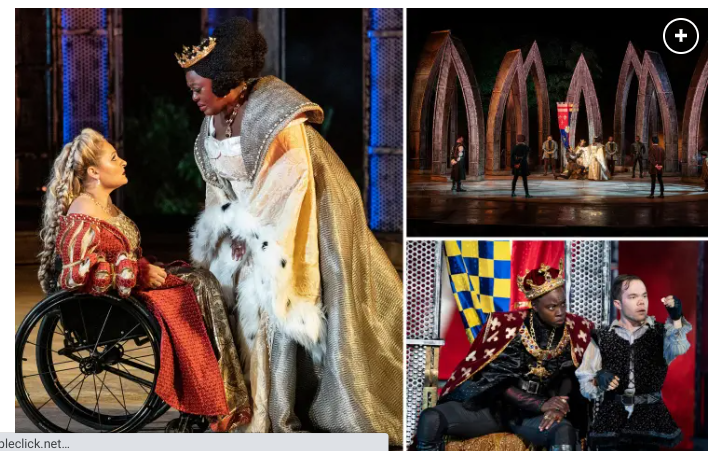
Danai Gurira as Richard III, Shakespeare in the Park, 2024

https://www.npr.org/2022/07/10/1110359040/why-it-matters-that-danai-gurira-is-taking-on-richard-iii

Unsurprisingly, with so many heady topics in the production, this Richard III is still somewhat controversial. Some right-wing critics dismissed the whole production as a piece of ‘woke propaganda,’ but I feel this is unfair.

When Danai Gurira of Marvel’s “Black Panther” first takes the stage in the title role, the actress has no perceivable hunchback or arm trouble. And yet the dialogue suggesting Richard suffers from a lifelong physical issue (“rudely stamped”) has been kept in. Perhaps we are to use our imaginations. Who knows? We are certainly tempted to close our eyes.

By Johnny Oleksinski

I will not judge this production based on the acting because I haven’t been able to see it. What I will do is take a stance on the validity of the concept. Specifically, I want to ask if this play is a good examination of toxic masculinity and if it would it be worthwhile to see it portrayed by a black woman, as opposed to a white man. The short answer is an emphatical “Yes.”

https://variety.com/2022/legit/features/danai-gurira-richard-iii-toxic-masculinity-central-park-1235318196/

Richard’s Toxic Masculity

Richard III is definately an example of toxic masculinity. He is violent, full of hatred, vengeance, and mysogeny. He is constantly insulting women from Lady Anne, Jane Shore, Queen Elizabeth, and even his own mother. In fact, the source of Richard’s toxic attitude is that he blames his mother for his disability and deformity:

Well, say there is no kingdom then for Richard;1635
What other pleasure can the world afford?
I'll make my heaven in a lady's lap,
And deck my body in gay ornaments,
And witch sweet ladies with my words and looks.
O miserable thought! and more unlikely1640
Than to accomplish twenty golden crowns!
Why, love forswore me in my mother's womb:
And, for I should not deal in her soft laws,
She did corrupt frail nature with some bribe,
To shrink mine arm up like a wither'd shrub;1645
To make an envious mountain on my back,
Where sits deformity to mock my body;
To shape my legs of an unequal size;
To disproportion me in every part,
Like to a chaos, or an unlick'd bear-whelp1650
That carries no impression like the dam.
And am I then a man to be beloved?
O monstrous fault, to harbour such a thought!. 3H6, Act III, Scene i, lines 1635-1653.

Now I should clarify the difference between deformity and disability, which are characteristics that Richard III has as part of his character makeup. According to the Americans With Disabilities Act, a disability is defined as: “A physical or mental impairment that substantially limits one or more major life activities.” This could include paralysis, autism, or any number of congenital or acquired conditions. Richard’s disability is primarily his limp (caused by his unequally shaped limbs), and his withered arm. What’s interesting in this production is that while the title role is played by an able-bodied woman, most of the rest of the cast have actual disabilites. Watch this clip of the famous courtship scene between Richard and Lady Anne, who plays her role in a wheel-chair.

While a disability is a legal term that is recognized by lawyers and governments alike, the term “deformity” is more subjective; it generally refers to any kind of cosmetic imperfection. In Richard III, this applies to Richard’s hump and withered arm. 

The Elizabethans thought that deformity was a sign of disfavor from God, and that deformed people were constantly at odds with God and nature, as Francis Bacon puts it in his essay, “On Deformity.”

As deformed people are physically impaired by nature; they, in turn, devoid themselves of ‘natural affection’ by being unmerciful and lacking emotions for others. By doing so, they get their revenge on nature and hence achieve stability.

Richard III has this drive for revenge in spades and I believe it manifests itself as a particularly terrible form of toxic masculinity. Richard definitely wants the crown to make up for his lack of ‘natural affection,’ but he is also especially malevolent towards women.

I, that am rudely stamp’d, and want love’s majesty

To strut before a wanton ambling nymph;

And therefore, since I cannot prove a lover,

To entertain these fair well-spoken days,

I am determined to prove a villain

And hate the idle pleasures of these days

Seeing a woman play this kind of misogynist dialogue forces the audience to take it out of context and question Richard’s point of view. We see casual misogyny every day, and seeing a woman deliver it is quite illuminating.

Richard’s deformity and Blackness

Another provocative choice by Danai Gurira’s portrayal of Richard is the fact that she plays the role of Richard without the hump or withered arm. She herself explains that for her production, Richard’s perceived deformity, is actually represented by her being a black woman:

He’s dealing with the otherness compared to his family, in terms of not being Caucasian and fair like them.” The word ‘fair’, is used a lot in the play.

Danai Gurira’s

Shakespeare writes Richard as constantly striving to compensate for his deformities by being clever, violent, and eventually, by becoming king. As I wrote before in my review of Othello, for centuries black people have been portrayed as inferior; aberrations of the ‘ideal fair-skinned form’. So, to the Elizabethans, blackness itself was a form of deformity, and the rawness of addressing this uncomfortable fact in this production should be commended.

English people are already trained—and we have scholars like Anthony Barthelemy has talked about this in his book Black Face, Maligned Race, where the image of blackness, as associated with sin, with the devil, all of these things, makes it quite easy to map onto then Black people these kinds of characteristics. Then, those kinds of characteristics allow for the argument that these people are fit to be enslaved. – Dr. Ambereen Dadabhoy, Race and Blackness in Elizabethan England Shakespeare Unlimited: Episode 168

https://www.folger.edu/shakespeare-unlimited/elizabethan-race-blackness-dadabhoy

So while I can’t speak to the production’s acting or staging, I will emphatically defend the notion that this production’s concept is valid. Richard III is an example of toxic masculinity through his self-hatred, violence, misogyny, and narcissism. In addition, as I’ve written before, in the Early Modern Period, blackness was considered an aberration or deformity, and seeing it in the person of Richard, with the implicit understanding that black people still face this kind of prejudice today, opens a much-needed dialogue that any production of Shakespeare shouldn’t be afraid to open.

In short, by re-contextualizing Richard’s deformity and disabilities, this production gets to the heart of the play’s moral for our times. The early modern period’s toxic attitudes towards deformity and disability created the Renaissance monster of Richard III. We in the 21st century must examine our own societal prejudices and toxic attitudes so this monster does not come to haunt us in real life.


Shakespearean Tropes In Marvel’s “Black Widow”

I really loved the new “Black Widow,” movie. Like many people, I think it’s long overdue that Natasha Romanov got her own movie, especially since in many ways, she’s the most tragic and dramatic of the avengers.

First of all, the performances are great, the fights are excellent, and the plot hints on many contemporary issues such as abuse, human trafficking, trauma, and PTSD, while not forgetting it’s a Marvel action movie. If you hated the movie, I won’t argue with you, but what I want to do is to point out that each character has inside them an archetype that Shakespeare used in his history plays about soldiers.

The four central characters Alexei Shostakov (David Harbour), Melina Vostokoff (Rachel Weisz). Yelena Belova, and Black Widow herself, Natasha Romanov (Scarlett Johanssen), represent in a sense, the full spectrum of how Shakespeare’s soldier characters cope with the trauma of war, and it’s fascinating to see their journey through the film.

David Harbour as Red Guardian. Black Widow, Disney 2021.
  1. Alexei Shostakov / Red Guardian: Sir John Falstaff. Alexi begins the movie motivated by a desire for glory, and becomes a braggart, a drunk, and overweight. The movie starts out with Alexei going undercover in Ohio as Natasha and Yelena’s father, when in reality he’s a Russian agent who becomes the only Soviet supersoldier. The Red Guardian was supposed to be the equal of Captain America and after (spoiler alert), Alexei is betrayed and sent to prison, he spends over 20 years telling tall tales about his ‘glory days’ and how he nearly defeated Captain America, (despite the fact that Captain America was frozen at the time). This is simmilar to how Shakespeare’s Sir John Falstaff lies about a daring robbery he committed at night, when in reality, he was robbed by his friends Poins and Prince Hal:
Henry V. Pray God you have not murdered some of them.
Falstaff. Nay, that's past praying for: I have peppered two
of them; two I am sure I have paid, two rogues
in buckram suits. I tell thee what, Hal, if I tell1180
thee a lie, spit in my face, call me horse. Thou
knowest my old ward; here I lay and thus I bore my
point. Four rogues in buckram let drive at me—
Henry V. What, four? thou saidst but two even now.
Falstaff. Four, Hal; I told thee four.1185
Edward Poins. Ay, ay, he said four.
Falstaff. These four came all a-front, and mainly thrust at
me. I made me no more ado but took all their seven
points in my target, thus.
Henry V. Seven? why, there were but four even now.1190
Falstaff. In buckram?
Edward Poins. Ay, four, in buckram suits.
Falstaff. Seven, by these hilts, or I am a villain else.
Henry V. Prithee, let him alone; we shall have more anon.
Falstaff. Dost thou hear me, Hal?1195
Henry V. Ay, and mark thee too, Jack.
Falstaff. Do so, for it is worth the listening to. These nine
in buckram that I told thee of—
Henry V. So, two more already.
Falstaff. Their points being broken,—1200
Edward Poins. Down fell their hose.
Falstaff. Began to give me ground: but I followed me close,
came in foot and hand; and with a thought seven of
the eleven I paid.
Henry V. O monstrous! eleven buckram men grown out of two!

Both Alexei and Falstaff fool themselves into thinking they’re still great heroes and manage to charm the other characters into giving them sympathy (to a point). Worst of all, even though he knows about the disgusting deeds of General Dreykov, the man responsible for the way Yelena and Natasha were recruited, brainwashed, forced to kill, and forced to be sterilized, he still defends the actions of Dreykov because Alexei benefited from the supersoldier program.

You both have killed so many people,” Alexei exults, embracing them both. “Your ledgers must be dripping, just gushing red. I couldn’t be more proud of you!”

Alexei

But in the climax of the movie, Alexei abandons his swagger in order to protect Natasha and Yelena; he goes from being a fake father to a real father. He also adopts a more Falstaffian view of ‘honor,’ as a thing not useful in itself:

Falstaff used this ‘catechism to become a thieving, conniving rascal, but the same words could be used to show how Alexei decided that his ‘family’ is more important than his persona as Red Guardian, how he values Natasha and Yelena more than his own glory.

2. Yelena Belova – Hotspur

Both Yelena and Hotspur are great warriors who work for the other side, but aren’t played as villains. Unlike the French in Henry V, the rebels in Henry IV Parts 1&2 are treated with respect by everyone, even the king they fight against! Likewise, even though she works for Dreykov, and was a willing assassin in his army of widows, she isn’t seen as a villain. She’s seen as a woman who had no other choice. She was raised to kill, so she did so, she just had the misfortune of being on the losing side.

Henry Percy is also a warrior fighting for the losing side This is why Hotspur has a lot of bitterness and envy towards Prince Hal- the man who gets to become a hero and king. Meanwhile Yelena is very jealous of Natasha, who not only became a valued assassin for Dreykov, she eventually became an Avenger and is seen as a hero by most people now:

“We’re both killers, but I’m not the one that’s on the cover of a magazine. I’m not the killer that little girls call their hero.”

Yelena- Black Widow.

Though in reality Natasha and Yelena are not sisters, they were raised together, trained together, and form a sister like bond, which makes the jealousy Yelena feels all the more poignant. Likewise, though Henry Plantagenet (Prince Hal) and Henry Percy aren’t brothers, everyone acts as if they were, even the Prince’s father:

 O that it could be proved
That some night-tripping fairy had exchanged
In cradle-clothes our children where they lay,
And call'd mine Percy, his Plantagenet!
Then would I have his Harry, and he mine.
But let him from my thoughts.- Henry IV, Part I, Act I, Scene 1.

In Black Widow, the envy the sisters feel towards each other is the central conflict of the movie, just as it is in Shakespeare’s play. Tragically, both works (spoiler alert), end the same way- with one warrior dying and the other essentially taking his or her place. In Black Widow, Yelena takes up the mantle after her sister sacrifices her life in Avengers Engame, but in Shakespeare’s version, the two Henry’s have a duel to the death:

Yelena represents the trauma that can destroy some soldiers when they don’t have someone to confide in. Everything she was told to believe in wound up being a lie, and everyone she trusted betrayed her. This is why she and her sister cling to the idea of family- the only thing that helps her get through the pain of their past.

Rachel Weisz as Melina Vostokoff. “BLACK Widow.” Disney/ Marvel, 2021.

3. Melina Vostokoff- Lord Northumberland I’ll keep this brief because Melina’s character has some MAJOR SPOILERS attached to her, but let’s just say she is the mother of the family and like Alexei she put her devotion to the Communist Party and to General Dreykov above all else, and failed to support her family, much like how Northumberland failed to support his son Henry Percy and let him get killed in the battle of Shrewsbury. I love Rachel Weisz’s performance in this part where she seems to mourn her lack of courage; she seems to deeply hate herself and what she’s done to her ‘daughters,’ which is painful to watch but very human.

Scarlett Johansen as Natasha Romanov/ Black Widow. “Black Widow.” Marvel/ Disney, 2021.

4. Natasha Romanaov/ Black Widow- King Henry V. Like Yelena, Natasha has to deal with the fact that she is a killer and has been trained to kill men, women, and sometimes even children. What’s fascinating to watch is how, even though she’s an Avenger and therefore one of the “good guys,” she knows that her actions have hurt people. It makes sense that in Age Of Ultron, she forms a close bond with The Hulk, since she probably sees herself as a monster.

For nearly 400 years, King Henry has been portrayed as a great hero on the stage, but ever since the Vietnam War, more recent productions have questioned whether his actions make him more of a hero, or a villain. He conquers France which he believes he legally owns but does that justify the bloodshed he’s committed?

One film that examines the ambiguous nature of Henry’s bloody conquest is Kenneth Branaugh’s 1989 movie, Henry V. Take a look at this clip at the end of the Battle of Agincourt. This was Henry’s greatest victory in the play and in real life, but after the battle, we see Kenneth Branaugh as King Henry slogging through the mud, looking at the bodies of French and English troops, with a look of pain and perhaps remorse on his face:

The Non Nobis number from “Henry V” directed by Kenneth Branaugh, 1989.

In Black Widow, Natasha is on a quest to make up for her past as an assassin and attempt to prevent more women from being recruited in such a dehumanizing way. Her kinship with the other widows, and her desire to help them, reinforces her humanity and makes her more than just a killer. Simillarly, her love for her sister and her love of the Avengers gives Natasha purpose and validation that she isn’t the monster she thinks she is. Finally, when her fake family joins her in the climax to defeat General Dreykov, she feels a strong sense of comraderie. Having her fellow soldiers, fight with her in a righteous cause makes her feel redeemed from her past.

Black Widow and Henry V are examples of how soldiers cannot survive a war alone. Even if they live through the war, the mental and physical scars of war are too much for one person to bear. This is why both films focus on how family is stronger than war, than causes, then pain, if one has the good fortune to have a group of people who love each other like a family, or as King Henry puts it:

We few, we happy few, we band of brothers;

For he to-day that sheds his blood with me

Shall be my brother; be he ne’er so vile,

This day shall gentle his condition:

Henry V, Act IV, Scene iii.

Thanks for reading this post, let me know if you’d like me to analyze any other movies in the comments. I’ll leave you with one more clip where Scar-Jo talks about her career as Black Widow: