How to Throw a Bridgerton Themed Party

Greetings Dear Gentle Readers,

With the new season just released on Netflix, I’m sure a lot of us literary nerds will rejoice and be happy to have an excuse to play dress up, eat some scrumptious food, and converse on the sweet little confection that is Bridgerton. What follows is by no means a comprehensive list of ideas, I just wanted to share some of my research that went into my own party in the hopes that it gives you ideas. Please feel free to respond to this post by commenting or by hitting me up on Twitter at @Shakestud and share your own Bridgerton Party Pics!

On A Personal Note:

Photo by rovenimages.com on Pexels.com

I seek you out at every social assembly because I know you will lift my spirits and make me see the world in ways I could not have imagined.”

Colin Bridgerton.

I need to give a special thank you to my wife in this post. She’s the one who introduced me to Bridgerton, did a lot of research into Regency etiquette and dining, and bought all the ingredients for the party. More than that, she is an extremely talented writer and educator who inspires me in ways even Penelope Featherington couldn’t enumerate. Watching Bridgerton has become a kind of nightly tradition for us and I am very grateful

Background: Bridgerton and the Gorgeous Georgian Era

Bridgerton is a period comedy on Netflix based on the popular novel series. It is set in an idealized version of the late 18th and early 19th century; a time when England was wealthy, cosmopolitan, and when one’s social standing was everything. The shows writers pay homage to great literary figures like Jane Austin, George Brimsley Sheridan’s The School For Scandal, Shakespeare (of course), and real-life scandal writers of the time; rags like Town and Country, The Spectator, and Courtesans.

My Personal Opinion on the SHow

Some people have criticized the show for not being historically accurate. Others claim that the show’s plots and characters are highly derivative from other comedies like Gossip Girl and others. I would argue that THAT’S THE POINT. Bridgerton is not trying to do anything original- it is nostalgia bait for literature nerds like me who know that shows like Gossip Girl are ripped off from classical sources. What Bridgerton does, is take these classic tropes, put them back into the period where they became popular, and then update the setting to make it more accessible to a modern audience. Much like the party ideas I’ll give you later, this show is like a sweet confection- comforting, unassuming, with an air of nostalgia and romance like a cup of tea and a crumpet.

https://www.vulture.com/article/bridgerton-characters-ranked-netflix.html

The show focuses on the hopes, dreams, and above all, loves of the Bridgeton family; a noble family in Georgian England. Viola, the matriarch of the house, seeks to find love matches for all her children and to avoid scandalous gossip. She does so through her own intelligence and through the help of her network of female friends, all while avoiding the watchful eye of Queen Charlotte (the powerful wife of King George III), and the mysterious scandal monger Lady Whistledown

Like its dazzling costumes, the show is very much fluff and feathers. Bridgerton’s use of color blind casting is extremely refreshing to me and it signals loudly and clearly that Bridgerton doesn’t want to be painstakingly historically accurate. This is an candy-coated and show that concocts an idealized version of Georgian society- one where painful racial problems are thrown out, there are few economic or political problems to sour one’s pallate, but everybody is rich and pretty and looking to fall in love with a wealthy eligible young man or lady.  So, with a concept this delicious, I knew I had to throw a party based on it!

Part One: The Invitations

There’s a ton of fancy invitations templates  online. Below is an invitation I created for free with an app called Canva and a parchment background picture I found online.
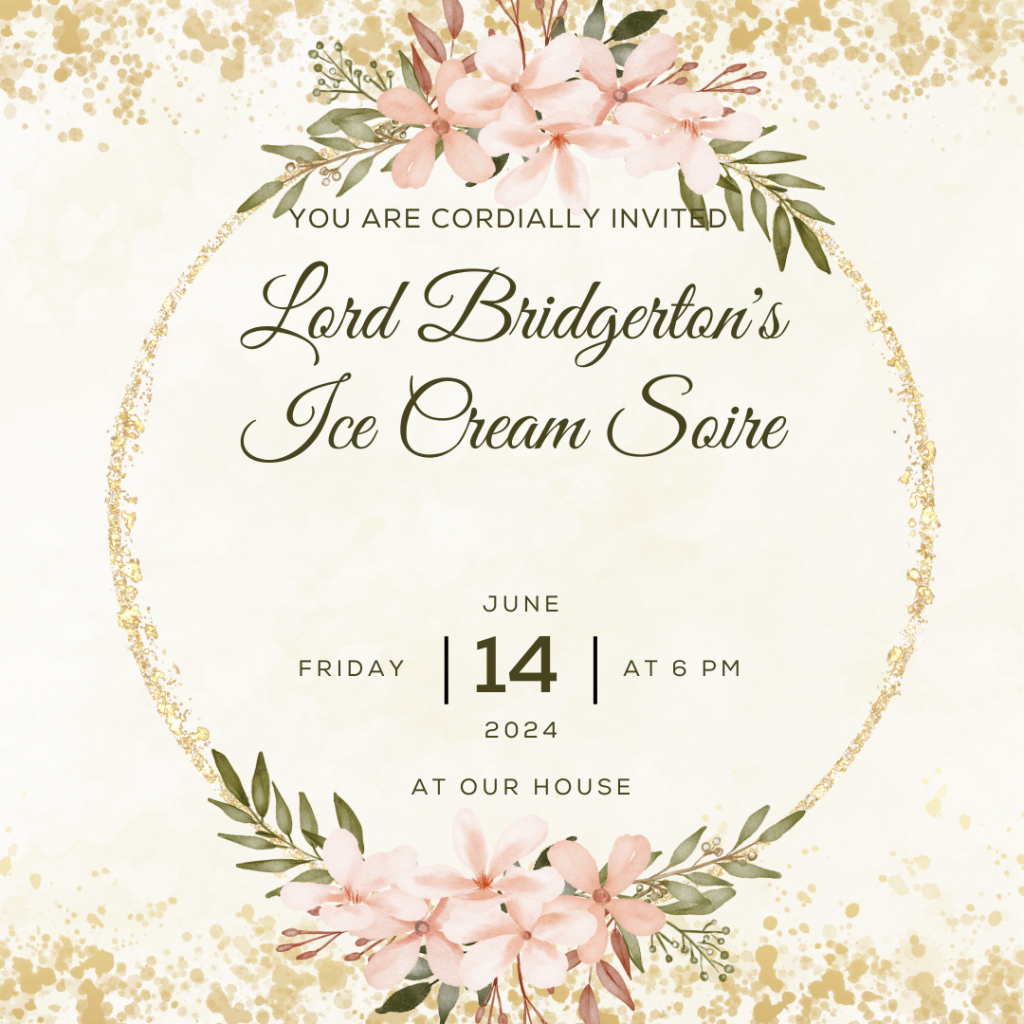
You probably also know that I am a huge fan of the website Immortal Longings because of their excellent Shakespearean art and they sell cards too. You can buy the cards or download the pictures on their website.

Shakespearean Greeting Cards from Immortal Longings.com

Part Two: Decorations

The Georgian Era was firmly in the Baroque era- a time known for opulence, excess, and as many frills as possible. Deck your home with as much gold, crystal lace as possible! Use electric candles liberally. Also, use curtains and fancy throw pillows to fancy up your dining room! Here are some more ideas from Chateau Challain:

Part Three: The Feast

As you can see, since the Georgian era was known as a time of wealth and excess, you could very easily break your wallet or your back trying to replicate an authentic Georgian dinner party, (especially if you lack an entire household staff to bring it to life). What we tried to do was distill some of my favorite foods from the Georgian era down and come up with an easy plan so that a plebian cooking-impaired soul like myself could make them at a reasonable price. I did not want my wife to have to cook for this, though she did wind up trying out a very interesting Georgian recipe:

Salmagundi

Thought I honestly doubt that the upper crust Bridgertons would ever eat this, it is an authentic Georgian recipe and it was common among middle class people, American Revolutionary War soldiers, and even pirates! It’s a savory salad that uses eggs, pickles, mixed greens and anchovies. The name is French for “hodge-podge” and it honestly can be swapped out with any number of ingredients. Here’s a recipe that’s pretty close to what my wife used:

https://ancestorsinaprons.com/tag/salmagundi/

1. dinner course- pie 🥧,  🥗 ,  cheese, grapes,  wine 🍷

Just like decor, a party or ball amongst the nobility was a sign of wealth and status. If you wanted to impress foreign dignitaries or net a wealthy spouse, you had to show off the wealth and sophistication of your household. We served duck as the main dish since it’s the sort of game the Bridgertons would have on their land. My wife and I also served a meat pie as an homage to the one Daphne eats excitedly in Season 1. Meat pies were very popular in the British isles due to the lack of refrigeration in the Georgian era. For our party, my wife bought the Steak and Stout pie from Trader Joes, which I realize not everyone likes, but it does have a good hearty feel to it. Accompanying the pie, we served cheese, grapes, and some good red wine!


Dessert

High tea is a real ritual in England to this day, and if you don’t have a lot of time or money on your hand it can be a bit daunting. Again, we relied on Trader Joes to help fill in the gaps of my cooking skills (since again, I wanted my wife to enjoy the party, not cook). I leaned heavily on ice cream, macarons, and of course, tea since they are all foods featured on the show. In fact, there’s a whole scene at the house where the family fight over the last chocolate macaron.
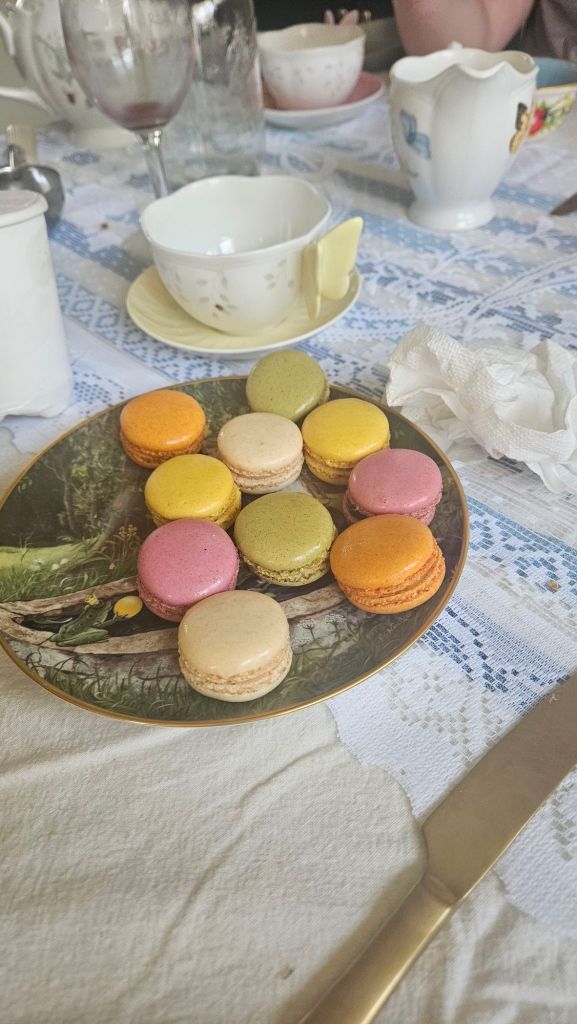
In case you don’t know, macarons are delicious French sandwich cookies made by sifting dry ingredients, combining them with egg whites, piping them onto a baking sheet, and baking them into light, flaky little half circles. From there you can add any kind of filling you like. Now, these cookies are notoriously temperamental, so I just bought some, but for the brave souls with a little more time on their hands, here’s a recipe from NYT:
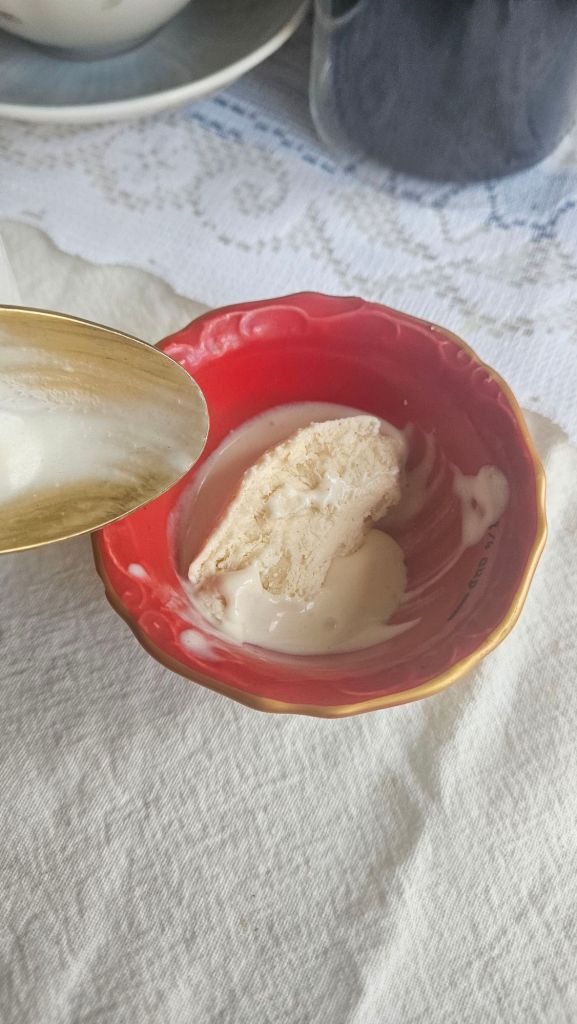
Other Dessert ideas: You could incorporate scones petit fours, or jam/ cucumber sandwiches. I find a dessert tower is really nice for this kind of “take what you like” dessert atmosphere. Also, don’t forget the ice cream!

Tea-

I’m sure I don’t need to tell you that tea has great cultural significance to the British and I labored over what kind of tea to serve during the party. I personally love Indian Chai and that would be appropriate since it’s mentioned in Season 2. I also enjoy Earl Grey (though that one might be too bitter for most people). However, I decided on Harney and Sons Paris Tea, which is my wife’s favorite, and in my humble opinion, is one of the best teas readily available. It’s a black tea that has been withered, rolled, and baked to make it more flavorful and aromatic, though easy to mass produce. I LOVE THIS TEA. Here’s a link if you want to learn more:

https://www.harney.com/pages/this-is-tea

Now, I should mention that there is a lot of officially branded Bridgerton tea, coffee, and tea snacks (of course), but this post isn’t an ad. If you’re interested in the branded stuff, here’s a few links below:


Music

Bridgerton is famous for featuring classical music covers of pop songs, which I really enjoy- it is a nice way of retelling the story of the characters by connecting them with something contemporary. Most of these covers were done by a group called the Vitamin String Quartet and there are playlists on Youtube, Spotify, and others.

During the Regency, music by Mozart and Hayden were all the rage, so if you want to intercut the covers with real classical music from the time period, you can also use them. I would recommend using waltzes or minuets if you want to get people on the dance floor:

Games

1.  Charades

2. Blind Man’s Bluff

3. Bridgerton official Games! There’s an official branded Bridgerton game where you write love notes as Lady Whistledown, while everyone else tries to guess who she is. Here’s a link to the Amazon site:https://www.amazon.com/Bridgerton-High-Society-Board-Game/dp/B0CC6SNRWV

Costumes:

Again, for people on a budget, you might want to forgo full Georgian outfits, but this was a time of ball gowns and elaborate wigs for ladies, and men with waistcoats, knickerbockers, and breeches. For more information on the period, here’s a link to Fashion History Timeline:

https://fashionhistory.fitnyc.edu/category/18th-century/

Well, that’s my advice, happy  Midsummer everyone!

And to conclude, I want to dedicate this post to my wife who introduced me to the wonderful, sweet, and heartfelt world of Bridgerton. I hope this post helps you bring a fun, fancy-but laid back evening into your home. I hope also that it helps you become closer to and appreciate your loved ones, just as I wish to keep enjoying the show with my wonderful wife.

The Fashion Is the Fashion 3: The Merchant Of Venice

Thanks for recommending this topic. I really enjoyed researching it. Disclaimer: Although I have a degree in Renaissance literature, I don’t have a degree in world religions. I don’t pretend to be an expert in Judaism and I apologize if I have gotten any cultural details wrong. As I have written before, this play has been used to spread harmful stereotypes and misinformation against Jews and Muslims, and I have no desire to do so. So don’t take this information as a comprehensive guide to the lives of Jews or indeed any 16th century Venetians. What I do intend to do is analyze how costumes from the play can evoke the people and cultures of that time.

1. Background https://youtu.be/BvqZ0JUljfo

Venice in the 16th century was a lot like modern day Manhattan- a multicultural epicenter of trade and commerce. https://youtu.be/FNZa9qazTvc

Many productions have costumes that emphasize the wealth and privilege of the Venetian world, except for Shylock

As this video shows, Jews in 16th century Venice were segregated into separate communities known as ghettos. Although the Jews found ways to survive and thrive in this situation, they faced constant discrimination and harassment.

In a modern productions or a period production the costume has to reflect a single vision for the show. Watch this interview with Globe Costume coordinator Laura Rushton: https://youtu.be/PaZmAuKE-Jg

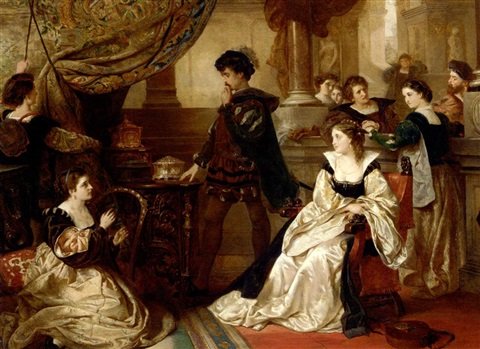
2. Men’s Fashion- Italian fashion was all the rage in Shakespeare’s day. Gone were the stiff woolen tunics of the Middle ages, in with brightly colored silks and leathers. Young Men wore leather jackets called doublets and tight pants that showed off their legs. In the hot sun of Venice, light linnen undershirts were wore underneath the doublet. Wealthy men would wear fine silks and their jackets had slashed sleeves to show off the fine embroidered silk underneath.

Joseph Fiennes’ costume as Bassanio in The Merchant of Venice

Servants- Servants were given distinctive clothes known as liveries by their masters, which for a man would typically be a distinct colorful jacket. Women like Narissa, who were high-ranking ladies maids, would wear hand me down clothes from their mistresses. So this is why in most productions I have seen, Narissa and Portia wear similar clothing. This also helps show the trust and respect they have for each other.

A Note On Masks:

Act II, Scene 5, takes place during Carnival, one of the most celebrated holidays of Venice, and it’s usually celebrated by people wearing brightly colored masks. This great video below from history YouTuber Metetron shows just a little bit of background on Venetian masks:

3. Women’s Fashion- The women in the play Merchant Of Venice are treated line birds in a cage, especially Portia who literally lives on an island and has to marry the man who wins her at a carnival! With the restrictions of garments like partlets, bodies, or corsets, if you wore the fashions of the period, you would feel like your lungs were birds in a cage!

Although the dress was richer and more ornate (reflecting the relative peace during this period), the clothing was much more physically restrictive than medieval dresses: https://youtu.be/KCeqG47LI1Y

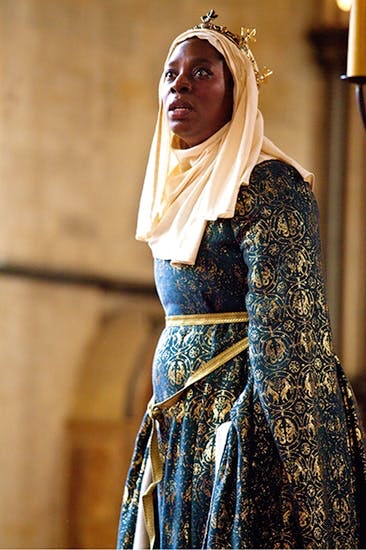
Costume for a production of King John. The fashion is reminiscent of the late 15th century. There is no corset, the dress helps shape the silhouette. Notice also the long sleeves.
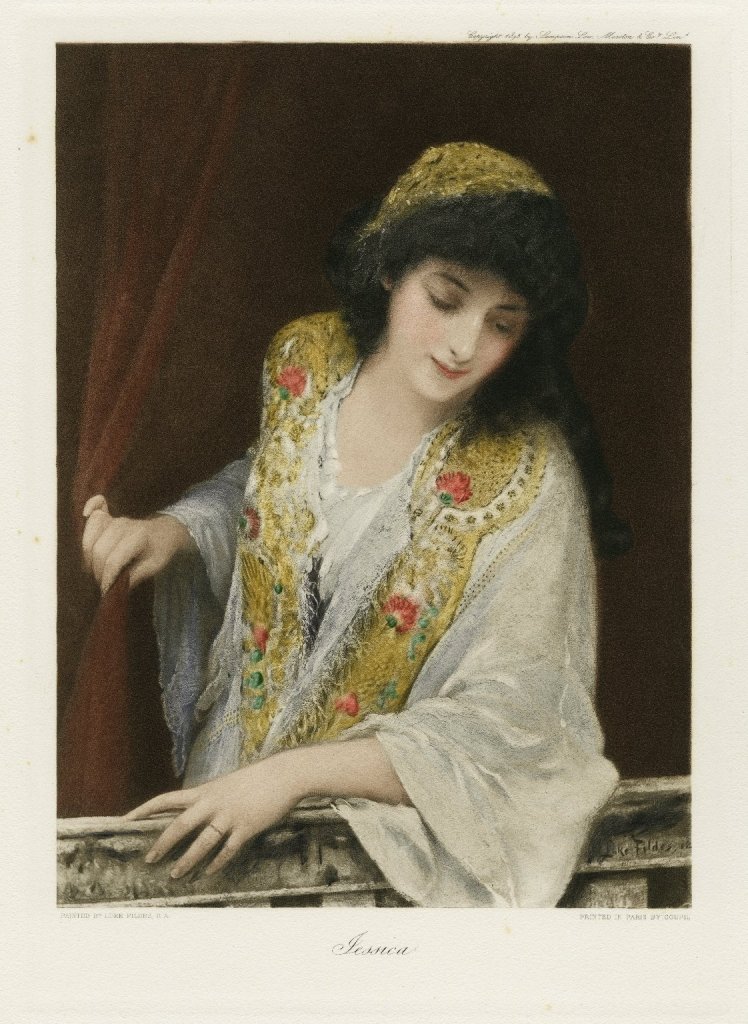
Jessica

Jessica- Though most productions have Shylock’s daughter dressing like the Christian women, there is a long history of distinctive clothing for Jewish women as well as men. Sadly, the only video I could find refers to 14th century clothes, I think this video is very informative and extremely thoughtful

4. Shylock

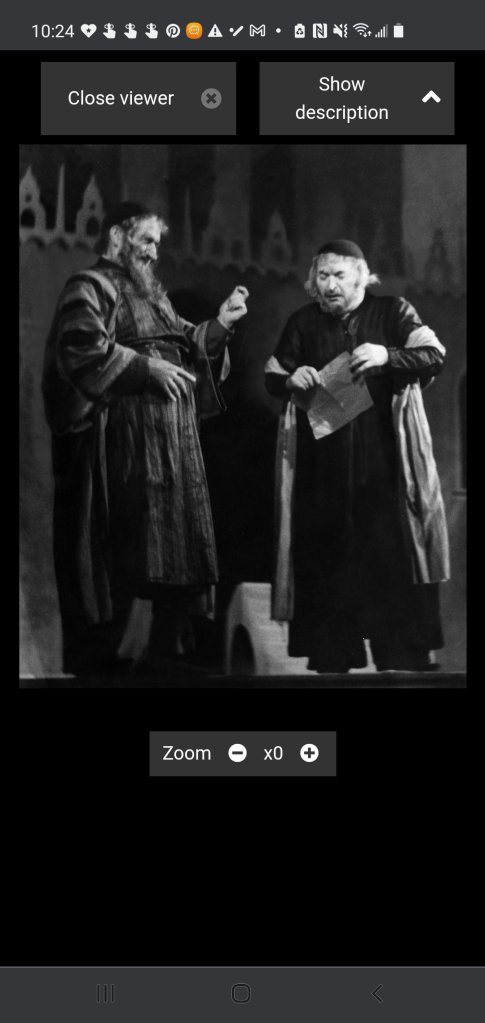
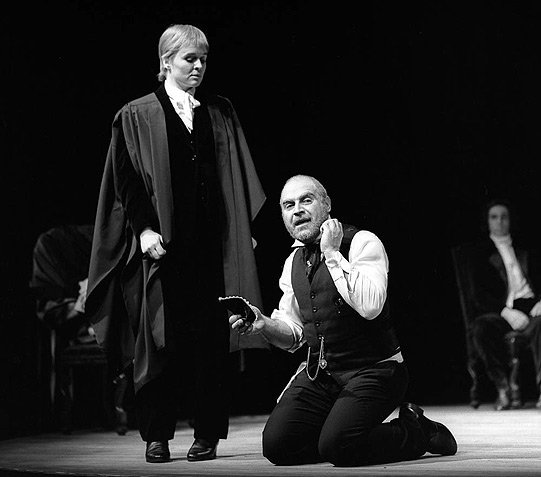
It’s worth noting that Shylock is not the central character in the story; the titular merchant is Antonio. Probably Shakespeare’s original audience saw him as a one dimensional villain for the audience to boo and hiss, then rejoice when he fails. He probably came onstage in 1596 wearing stereotypical red wig, a long gown, and a grotesquely oversized nose. The costume and performance gave the impression of someone foreign, alien, even demonic. This was one reason why some modern actors have balked at playing Shylock, as Patrick Stewart explains: https://youtu.be/7UOdMHW7J2Q

That said, Shakespeare clearly didn’t write him as one dimensional; he dominates the scenes he’s in and for centuries great actors have yearned to play Shylock over all the other characters. Slowly Shylock has become the focus of the play and the romantic comedy aspect has become less and less important in most modern productions. Like every great part, Shylock’s costume proclaims his social class, his background, and his relationship with other people.

In the play, Shylock only refers to his clothes once, referring to the gown he wears as “My Jewish gaberdine.” A Gaberdine is a long cloak like the one in the painting above, but as you can see, Jews were not the only people wearing them.

Because of rampant antisemitism and fear of the growing influence of the Jewish community in the 16th century, the Senate and local magistrates segregated and kept constant watch on the Jews of Venice, and one way they did that was by forcing Jewish people to wear distinctive clothes.

According to the Online Jewish Museum:

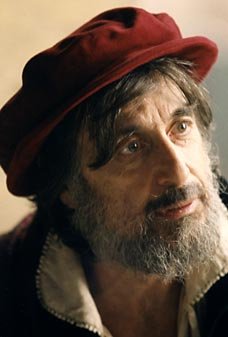
Jews were forced to wear various markings on their clothing to identify themselves as Jews. In 1394 they had to wear a yellow badge, it was changed to a yellow hat in 1496 and to a red hat in 1500.

Charles Keen as Shylock

As Shylock grew in popularity with actors and audiences, actors played him with more nuance. Contrast the foreign looking gown in the previous picture, with Charles Keen in the 19th century.

That is not to say that all productions played Shylock as a fully formed human: in 1934, the Nazi Party sponsored a German production of Merchant with horror actor Werner Krauss, (famous for films like The Cabinet of Dr. Caligari) as Shylock. You’ll notice that the costume again emphasizes otherness, and exaggerates Jewish stereotypes.

Warner Krauss in the infamous 1934 production of Merchant sponsored by the Nazi party.

Patrick Stewart when he played Shylock in the 1970s, emphasized how Shylock is essentially an immigrant in his own country and played him with tattered clothes, a dirty bushy beard, and with an air of a stray dog. His clothes emphasise both his race’s oppression, while also telegraphing Shylock’s miserly attitude. Sir Patrick emphasized that his Shylock had lost so much in his life that he clings to Earthly wealth to feel in control of his life.

Patrick Stewart as Shylock
David Suchet as Shylock
David Suchet as Shylock, RSC.

By contrast, David Suchet. (famous for his portrayal of detective Hercule Poirot), chose a near polar opposite interpretation of Shylock at about the same time. The main difference between Suchet and Stewart could basically be summed up by this fact, Suchet is actually Jewish, Stewart is not.

Because Stewart was portraying a member of a community to which he didn’t belong, his portrayal downplayed Shylock’s Jewish identity since he didn’t want to make assumptions about what being Jewish is like. This is why Stewart gave his Shylock an over-refined accent and made sure his costume didn’t emphasize any stereotypical Jewish elements.

Since Suchet actually is Jewish, he did not shy away from portraying Shylock’s jewishness. His Shylock is proud of being Jewish but is well aware of how other people see him. He knows that he is othered by the other Venetians, and can use their fear and hatred of him as a weapon against them. Suchet also dressed his Shylock as well to do, but not gawdy to try and command respect from other people, but also carried around a walking stick to use as a weapon.

Ian McKellen
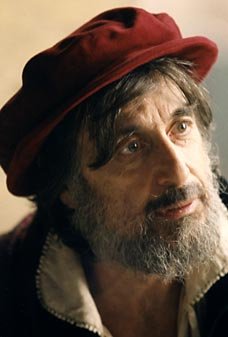
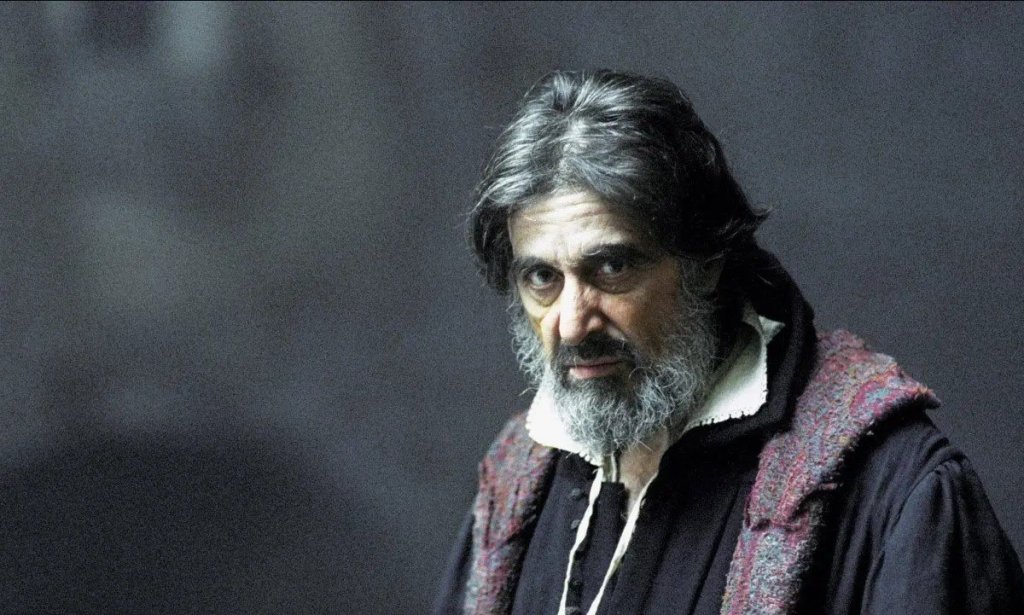
Al Pacino in the 2009 movie of Merchant, wearing the red hat that real Jews were required to wear in the 1590s.

6. Case study: the 2009 movie

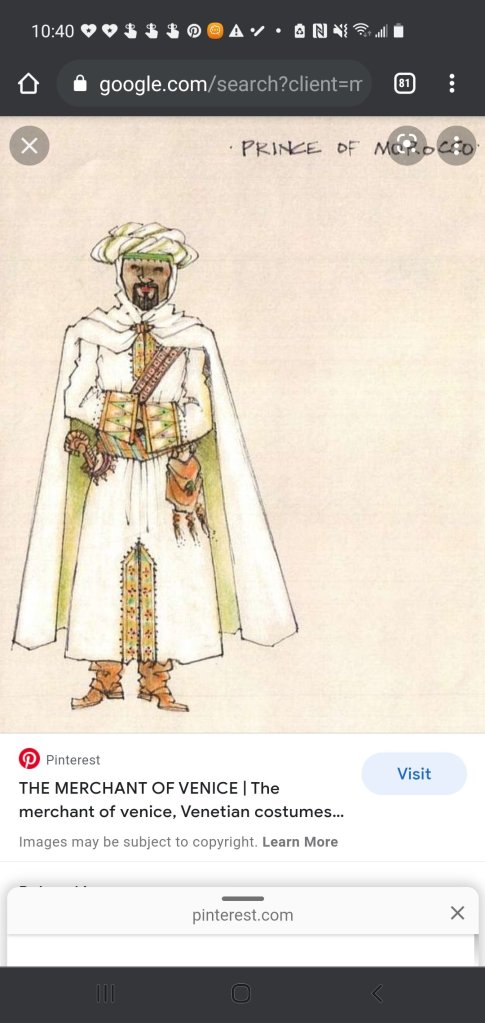
The Prince of Morrocco: In Act II, Scene 7, The Princes of Morrocco and Aaragon (A region of Spain), come to Portia’s home on the island of Belmont to try solve the riddle of the three caskets. In order to show the audience that these men are foreigners, their costumes have to be distinct from the Venetians. Take a look at this was accomplished in the 2004 movie:

The Prince of Morrocco (David Harewood) tries to guess the casket in the 2004 movie.

Mr. Harewood’s costume was inspired by the real Morroccon ambassador to Queen Elizabeth, Abd el-Ouahed ben Messaoud, who many scholars believe, might have also inspired Shakespeare to write Othello 6 years later.

Abd el-Ouahed ben Messaoud
Al Pacino dons the distinctive red cap that all Venetian Jews were required to wear in the 1590s.
Shylock after he converts to Christianity.

6. Works Cited

https://www.bl.uk/shakespeare/articles/a-jewish-reading-of-the-merchant-of-venice

Venetian Fashion in the 16th Century

https://en.wikipedia.org/wiki/1550%E2%80%931600_in_Western_European_fashion

1590-1599

Scary Shakespearean Stories!

“Let us sit upon the ground, and tell… THE MOST MESSED UP, MACABRE, EVIL SHAKESPEARE STORIES EVER!”

I have three macabre stories that are 100% true relating to Shakespearean plays, just in time for Halloween!

Lithograph of a demon tempting John Wilkes Booth, created by John McGee in 1865.
Tale #1: Life Assassinates Art. Everyone knows John Wilkes Booth was an actor who murdered President Abraham Lincoln at Fords Theater, on April 14th 1865. However, not too many know that he was a Shakespearean actor, and that his experience with the Bard’s play of Julius Caesar, might have encouraged Booth’s murderous hand!

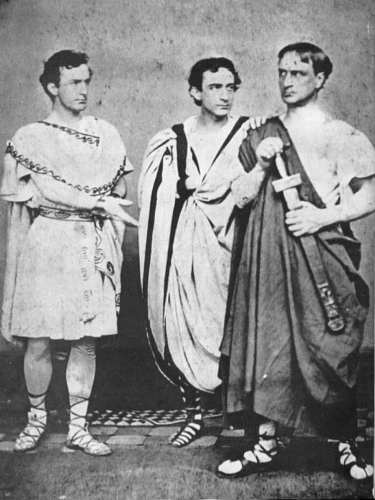
The whole Booth family were  a Shakespearean theatrical dynasty; John Wilkes and his two brothers, Edwin and Junius-Brutus Booth Jr were professional actors. The three brothers only appeared together onstage once: in a benefit performance of Julius Caesar- which as you know from my previous posts, is a play where the noble Roman Brutus becomes the head of a conspiracy to assassinate a dictator in the name of peace and freedom. Booth’s father coincidentally was Junius Brutus Booth, and many scholars suspect that Brutus’ son might have taken inspiration from this ancient Roman assassin. In John Wilkes Booth’s mind, Lincoln was a tyrant oppressing the south, and it was up to him to “nobly” sacrifice himself for the good of the Republic.

Photo from the 1864 benefit performance of "Julius Caesar," starring John Wilkes Booth, Edwin Booth, and Junius Brutus Booth Jr (left to right).
Photo from the 1864 benefit performance of “Julius Caesar,” starring John Wilkes Booth, Edwin Booth, and Junius Brutus Booth Jr (left to right).
In the photo on the left, you can see the three Booth brothers onstage as Julius Caesar. In a true twist of fate, John Wilkes did not play one of the conspirators Brutus or Cassius, (who stab Caesar in the back), but Marc Antony, the man who spoke for Caesar at his funeral and incited all Rome to avenge his murder. Five months after this photo was taken, Booth shot Lincoln onstage at Ford’s Theater, and shouted in Latin: “Thus shall it be to all tyrants.”

And the Julius Caesar parallels don’t stop there: just as Caesar’s wife had dreams predicting his murder, President Lincoln was haunted by dreams that warned him of his own death which he told his own wife, Mary Todd Lincoln. Days before the assassination, Lincoln himself had a terrifying vision:

“About ten days ago, I retired late. I soon began to dream. There seemed to be a death-like stillness about me. Then I heard subdued sobs, as if a number of people were weeping. I thought I left my bed and wandered downstairs. There the silence was broken by the same pitiful sobbing, but the mourners were invisible. I went from room to room; no living person was in sight, but the same mournful sounds of distress met me as I passed along.

“It was light in all the rooms; every object was familiar to me, but where were all the people who were grieving as if their hearts would break? I was puzzled and alarmed. What could be the meaning of all this? Determined to find the cause of a state of things so mysterious and so shocking, I kept on until I arrived at the East Room, which I entered. Before me was a catafalque, on which rested a corpse wrapped in funeral vestments. Around it were stationed soldiers who were acting as guards; and there was a throng of people, some gazing mournfully upon the corpse, whose face was covered, others weeping pitifully.

” ‘Who is dead in the White House?’, I demanded of one of the soldiers.

” ‘The President’, was his answer, ‘He was killed by an assassin.’

“Then came a loud burst of grief from the crowd, which awoke me from my dream. I slept no more that night; and although it was only a dream, I have been strangely annoyed by it ever since.” (reprinted from http://www.prairieghosts.com/a_lincoln.html). 

The tragic tale of Lincoln mirrors in many ways the assassination of Caesar, a man who to some was a tyrant and to many was a savior. Surely few other moments from history demonstrate Shakespeare’s poignancy, in a more gruesome and macabre way.

Works Cited:

  1. Andrews, John F. “Was the Bard Behind it,” The Atlantic. Accessed from http://www.theatlantic.com/magazine/archive/1990/10/was-the-bard-behind-it/308480/
  2. http://shakespearestaging.berkeley.edu/index.php?option=com_g2bridge&view=gallery&Itemid=256&g2_view=core%3AShowItem&g2_itemId=15120&g2_imageViewsIndex=1
  3. http://www.loc.gov/pictures/item/2003689283/
  4. http://www.prairieghosts.com/a_lincoln.html