Intro to Coriolanus


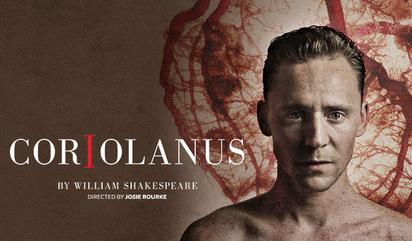
Why no Coriolanus?? David Oyelowo is playing him at the National Theatre and it’s the one analysis of Shakespeare you don’t have! Please hurry! I’m seeing it on Friday!

User Noittickles, sent to me today

Well, with a request like that, how can I refuse!

Coriolanus is the only Shakespearean story about Republican Rome, which is to say, before Julius Caesar turned Rome into a dictatorship. The play has been called pro-democracy, pro-monarchy, fascist, Marxist, and many other things. In some ways, the play is rather simple and its verse isn’t much fun to read, but the questions it poses, and the way Coriolanus shows the clash between power and common people, makes it fascinating to think about.

The play’s title character is also the most opaque one Shakespeare ever wrote. Some say he is a war hero, undone by the mob. Some say he is a want-to-be dictator who hates the common people and wants to keep power among the military elite. Unlike Hamlet, Macbeth, or any of Shakespeare’s other tragic heroes, we never get a sense of his true intent, or his actual feelings on anything. 

To illustrate this, let’s look at two very different interpretations of the same speech. In Act III, Scene iii, the tribunes (representatives of the commons in the Senate), have organized a smear campaign to prevent Coriolanus from becoming Consul, (the highest rank a Roman aristocrat could achieve before Emperor Augustus). Coriolanus is furious at the Tribunes, and vows to leave Rome to take his revenge on the city. Here’s the text of the speech:

Coriolanus. You common cry of curs! whose breath I hate
As reek o' the rotten fens, whose loves I prize
As the dead carcasses of unburied men
That do corrupt my air, I banish you;
And here remain with your uncertainty!
Let every feeble rumour shake your hearts!
Your enemies, with nodding of their plumes,
Fan you into despair! Have the power still
To banish your defenders; till at length
Your ignorance, which finds not till it feels,
Making not reservation of yourselves,
Still your own foes, deliver you as most
Abated captives to some nation
That won you without blows! Despising,
For you, the city, thus I turn my back:
There is a world elsewhere.
[Exeunt CORIOLANUS, COMINIUS, MENENIUS, Senators,]
and Patricians]
Aedile. The people's enemy is gone, is gone!
Citizens. Our enemy is banish'd! he is gone! Hoo! hoo!

In the first speech, Tom Huddleston plays Coriolanus as a heroic soldier, disgusted and hurt by the lies of the scheming  Tribunes:

Hiddleston chose to play Coriolanus not as a villain but as a frustrated demagogue- someone who wants to lead his people to greatness, whether they like it or not. Whether you approve of his methods, Hiddleston’s Caius Martius does care about the good of Rome. You can almost see the tears in his eyes as he leaves the city he loves, the city he bled for, and that has now betrayed him.

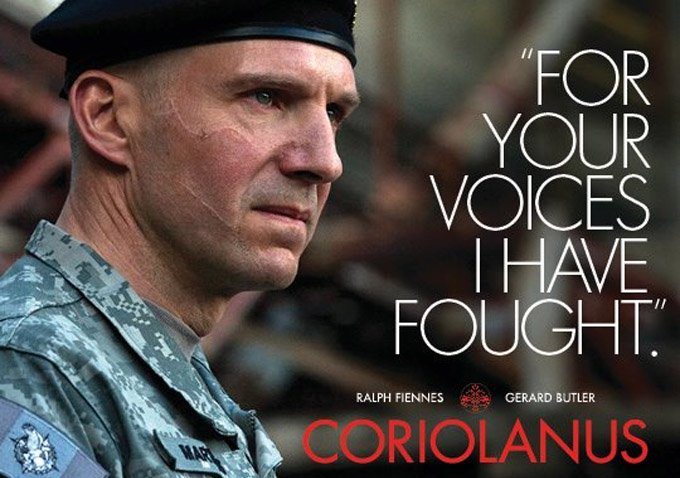
By Contrast, Ralph Fiennes takes a much more authoritarian and cruel route in the film Coriolanus, which Fiennes also directed:

Youtube critic Kyle Kallgren made the excellent case that Fiennes’ Coriolanus is first and foremost, a soldier. You could argue that perhaps Coriolanus has no political ambition whatsoever; he merely wants to keep fighting because war is all he knows. Maybe he purposefully sabotaged himself during his campaign for Consul, because all he wishes to rule is the battlefield:

Kalgren also highlights the “proto fascist” parts of Fiennes’ performance, since Fiennes himself has played Nazis, serial killers, and of course, Lord Voldemort, who is essentially a fascist dictator. Like Merchant of Venice, the Nazi party used Coriolanus as a propaganda tool, claiming that Caius’ fall from grace showed the failure of a weak democracy:

The poet deals with the problem of the people and its leader, he depicts the true nature of the leader in contrast to the aimless masses; he shows a people led in a false manner, a false democracy, whose exponents yield to the wishes of the people for egotistical reasons. Above these weaklings towers the figure of the true hero and leader, Coriolanus, who would like to guide the deceived people to its health in the same way as, in our days, Adolf Hitler would do with our beloved German Fatherland.

Martin Brunkhorst, “Shakespeare’s Coriolanus in Deutscher Bearbeitung. Quoted from Weida

It makes sense that fascists would gravitate towards a play about a seemingly virtuous Roman military leader. After all, the word “fascism” is an Italian word, coined by Benito Mussolini, to evoke the glory days of the Roman Empire- days when Roman society was based on military conquest under a strong leader. What these fascists fail to recognize is that Coriolanus is not a strong leader- he hates politics and is unable to gain any support from the people or from the elites in power. His inability to “play the game” of Roman politics, does make him appealing to some, but on the whole, his career is a disaster.

Some have chosen to interpret the story of Coriolanus as a sort of action-movie wish fulfillment- a man in a lawless society who uses his fists rather than words. Back in the 1990s, Steve Bannon (former advisor to President Donald Trump), wrote a hip-hop musical called: The Thing I Am, which re-interpreted the story of Coriolanus as a police captain who is trying to clean up downtown LA, which is embroiled in gang warfare. I find this interpretation paper-thin and not at all conducive to the spirit of the original play. It also has very racist and paternalistic undertones. You can read my review of it here:

Coriolanus Today

https://www.nationaltheatre.org.uk/productions/coriolanus/

Shakespeare refuses to be prescriptive on political or social issues. He tries to represent all sides of an issue and let the audience decide. With the rise of neo-fascist movements, sectarian violence, and the persistent questions surrounding police and military forces, Coriolanus is more relevant than ever. I haven’t seen this production at the National Theater, but I hope it calls attention to the various angles and points of view of the play- Coriolanus the war hero, Coriolanus the traitor, Coriolanus the soldier, Coriolanus the would-be-dictator. David Oyelowo is a fantastic Shakespearean actor, so I’m sure he can bring a great deal of complexity and nuance to this complicated man.

What I find interesting is that the trailer chooses to use this speech, when Coriolanus has defected to Rome’s enemies, the Volskies. He seems sorrowful, desperate, and afraid of what the Volskies will do to him, now that he is in their camp. One line that Oyelowo delivered exceptionally well was the line “Only the name remains.” I haven’t seen the whole play, but it seems THIS Coriolanus is concerned with the glory of his name living after him. The final question this play asks is, for such a complicated man, how will Coriolanus be remembered?

Well, there you go, Stopittickles! Hope you enjoyed this overview of the play Coriolanus. If you like this review, you might like to sign up for my online class on Julius Caesar via outschool.com:

Click here to sign up and get a $5 discount: https://outschool.com/teachers/The-Shakespearean-Student

Is Harry Potter Hamlet?

1. Introduction

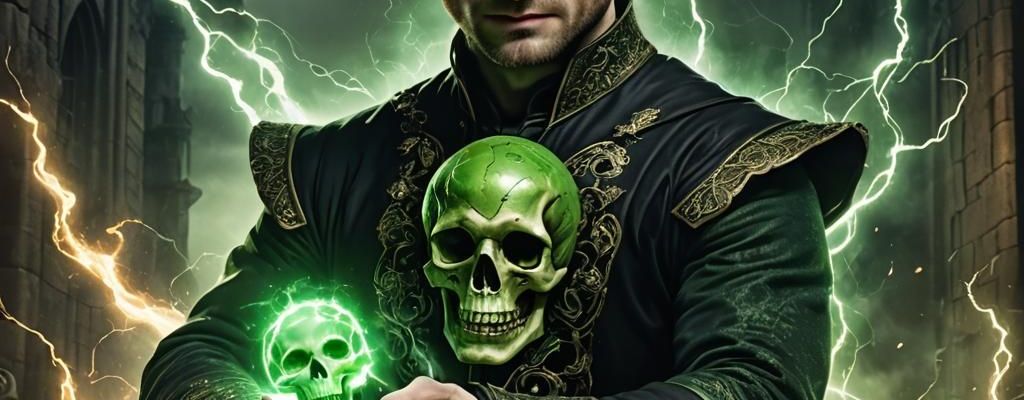
Hamlet as a Hogwarts student (AI artwork)

As is often the case for me, I like to get at the heart of what makes a piece of pop culture relevant and compare it to Shakespeare. I wish to stress that Shakespeare is not the source of all great art, but at the same time, he knew where to find the source of art, and most great art has some sort of Shakespearean influence.

2. Plot

Harry Potter as Hamlet (AI artwork)

In the case of Harry Potter, we have some surface plot similarities to Hamlet: a young man brooding over the loss of his parents, who takes revenge against the man who took them from him. Both stories also have a powerful autocrat who is  associated with snakes:  

The serpent that did Sting thy father’s life

now wears his crown.

Is Harry hearing voices? Chamber of Secrets

In both Harry Potter and Hamlet, the hero’s friends worry that he’s losing his mind; in the second book: Harry Potter can hear the basilisk because he speaks the snake language. Nobody else can understand what he’s hearing, and they conclude Harry is hearing voices. Meanwhile, Hamlet is the only one who hears the ghost of his father:

In the fifth book, Harry Potter and the Order of the Phoenix, Harry can hear voices coming from a vale between the land of the living and the land of the dead, because he saw death at a very young age. This isolates Harry from other characters, (who have not suffered loss), and they once again think that he is losing his mind.

Hamlet and Harry have a visceral understanding of grief; they understand that when one is experiencing grief, one sees the world in a way that most other people can not comprehend. In a way, insanity is a metaphor for grief, and both characters (both of whom, by the way, spend most of their time wearing black) personify how this grief changes their worldview.

The fundamental difference between Hamlet and Harry Potter could be summarized like this; Hamlet is devoted to his father, Harry to his mother. The ghost of Hamlet’s Father sets the action of Hamlet into motion, as he demands that his son revenge his murder. By contrast, Harry Potter is constantly inspired by his mother. Although he only sees his mother for a short time, it’s what he learns about her that drives many of Harry’s actions. Even after death, the memory of Lilly’s kindness and love not only inspires Harry, but other characters like Snape, Slughorn, Dumbledore, Sirius, and Lupin. Lilly’s memory rallies all the heroes to unite and defeat Voldemort.

In addition, Harry’s choices emulate his mother’s personality more than his father’s. Harry’s primary concerns are to stop Voldemort from taking over the Wizarding World, to show kindness and respect to everyone, and to guard his friends with his life if necessary, just as his mother did for him. In other words, the matriarchal virtues of love, self-sacrifice, and familial devotion drive Harry, not a patriarchal desire for vengeance which drives Hamlet. Therefore, Harry Potter is a more modern Hamlet, driven by a desire to improve a world and a community, rather than just “The royal bed of Denmark,” which Claudius has defiled.

The Melancholy Dane is driven by anger over his father’s untimely and foul murder and the sadness of losing him. Many actors have chosen to play Hamlet as a man who wants revenge, but one for whom vengeance doesn’t come naturally. Hamlet’s conscience, his scruples, his gentleness, and sometimes his sympathy for Claudius, blocks him from quickly taking revenge. In the clip below, Ethan Hawke is literally watching an avenger in a movie (Brandon Lee in The Crow) on a movie screen. It’s as if Hamlet is looking at a reflection of what he wishes he could be- a decisive, ruthless avenger:

As mentioned before Harry Potter’s ability to command loyalty, friendship, and respect from others allows him to accomplish his goals; he succeeds by rallying everyone, his friends, family and even his enemies to unite and fight. By contrast, Hamlet is a man who cannot trust anybody and therefore must rely on his own cunning (and sometimes ruthlessness), in order to achieve his goals.

Harry’s powers to mobilize the best in people are the powers that the dark Lord did not understand. Like a tyrant, Voldemort keeps all the power to himself; he rules by being more powerful than the people around him and inspiring fear. This makes him vulnerable when his foes band together, and his friends desert him, like when Laertes implicates Claudius for killing Hamlet and finds himself alone, friendless, and ready to taste Hamlet’s revenge:

When Shakespeare sat down to write Hamlet, the Elizabethan age was very cut throat- England had gone through the Civil War, violent factions were springing up at court, and Elizabeth herself suffered multiple assassination attempts. Hamlet is very much a product of a time where everyone is worried about being watched and betrayal can happen at any moment. By contrast, Harry Potter was written at another paranoid time- right after the September 11th attacks where racism, homophobia, and xenophobia were (and to a certain extent, still are), ripping the world apart. For all her faults, JK Rowling created a new kind of Hamlet figure, one who tries to bring people together in times of fear and grief, not one who wishes he could be “bounded in a nutshell” or that his “too too solid flesh”Close Reading: “Oh That This Too Too Solid Flesh” would melt away.

3. A Common Ancestor- Hercules

Like all Renaissance playwrights, Shakespeare took inspiration from ancient Greek and Roman sources. Scholars have seen echoes of Orestes, Perseus, and of course, Oedipus in Hamlet, but one Greek myth that pops up in both Hamlet and Harry Potter is the myth of Hercules. Here’s a short list of commonalities:

1. Both heroes defeat a serpent as a baby and is raised by people who aren’t his parents. Hercules strangles snakes in his cradle, Harry defeats Voldemort, and Hamlet (who is still a child), defeats his uncle who is called a serpent by the Ghost.

2. Cursed by a malevolent creature who hates his mother. Harry gets his scar, Hercules is cursed by Hera (his father’s wife, but not his biological mother). Hamlet

3. Labors involving wild beasts- Nemean Lion (sorting hat), Hydra= basilisk. 3. Captures a stag (Conjures a patronus) 4. Boar= Troll 5. Stables= basilisk in the bathroom 6. Stymphalian birds= golden snitch 7. Girdle of Hipolita= Ravenclaw diadem 8. Cattle of Geryon= other horcruxes 9. Golden Apples= mermaid egg guarded by dragon

10 and most obvious- BOTH OF THEM FACE A THREE HEADED DOG

I bring this up because in many ways, Harry Potter, Hamlet, and Hercules are timeless myths that represent what Joseph Campbell called “The Hero’s Journey”- an eternal story of growth, struggle, death, and rebirth that transcends time, place, and cultures.

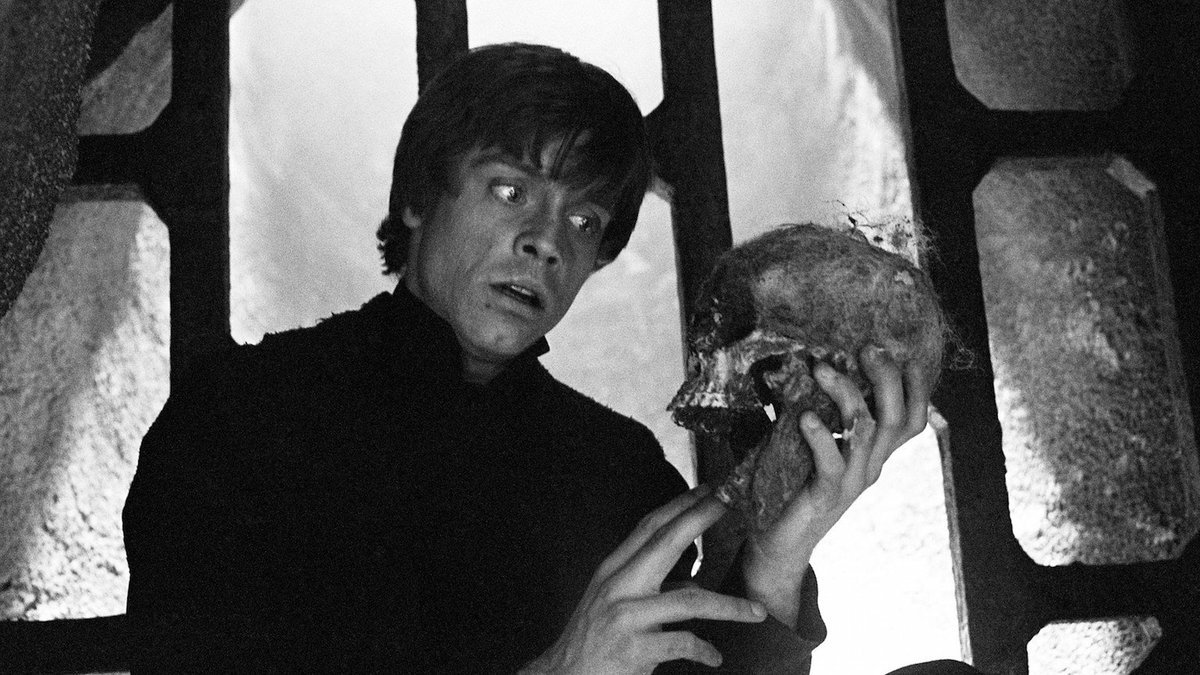
Another character that shares a lot of similarities with Hamlet and Harry Potter is Luke Skywalker from Star Wars. If you enjoyed this analysis of Shakespeare and Harry Potter, you might enjoy my course on Shakespeare and Star Wars from Outschool.com:

This two-week course is fully online and fully immersive. You can learn about Shakespeare through the lens of Star Wars, (and like this post), you will learn about characters, plots, and the ideas behind classic stories by comparing them to contemporary pop culture. Click the link below to get started:

Thanks so much for reading, and stay tuned for more insightful content!

New Course: Shakespeare’s Histories

Shakespeare’s History Class

Course trailer

Parent Description- A fully online, fully interactive course into Shakespeare’s histories taught by a professional text coach and actor. 

Students- Uncover the scandalous and gory history behind Shakespeare’s most action-packed plays! Shakespeare’s histories have inspired such works as “Empire,” “Game of Thrones,” “Hamilton” and even the “Star Wars” trilogy. This class will unlock for you why these stories of power and betrayal have been so popular for 400 years.

Format:

0. The class will have a Nearpod with slides, activities, and links to my other resources.  The class will be a combination of slides, activities, and videos. Each class will have 

  1. Weekly Discussion questions via Google Forms such as: “What do you know about Shakespeare the man?” or, “Are Shakespeare plays still relevant today?”
  2. Video Analysis- Every week I’ll discuss a different play with a short video.
    1. I’ll provide some context, explaining what is happening in the play durin the speech, and any relevant historical context.
    2. We’ll watch a recording and the students can write their impressions on what they like and don’t like.
  3. Immersive activities such as:
    1. – Shakespeare arts and crafts and recipes such as making costumes and props.
    2. – My online Shakespeare board game.
    3. Virtual tours of the Tower Of London,
  4. Weekly Web Quests like “find a Shakespeare quote that you use in normal speech,” “find a movie or character that’s based on Shakespeare,” or “Draw a picture of a Shakespearean character (stick figures are acceptable).

6 Week Course

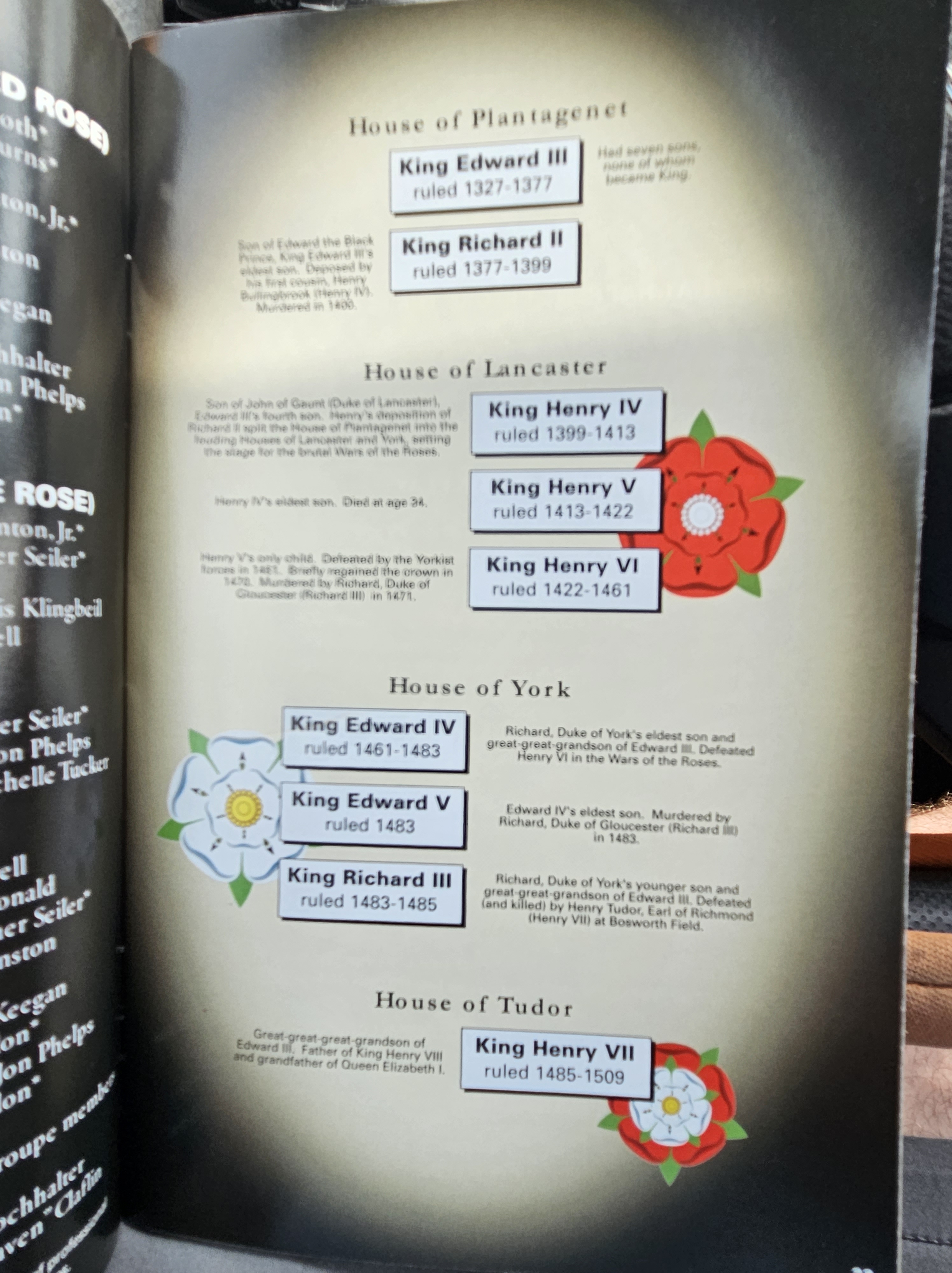
Week 1 – Why Hamilton is Like A Shakespeare History Play Hamilton and Shakespearean History We’ll discuss what makes a history play a history play, why they were so popular in Shakespeare’s day, and draw parallels between Shakespeare and the Broadway Musical “Hamilton.”

  1. What is a history play?
  2. Song quest: Watch the Horrible histories king song
  3. Worksheet- which Shakespearean character reminds you most of Hamilton?
  4. Video- the 10 Duel commandments of Shakespeare

Week 2- Richard II

  1. The history of Richard Shakespeare’s Richard II | Animated short
  2. Watch the presentation and fill in the blanks of the story: Richard the Second Intro Presentation
  3. Web quest- go online and write down three things about the Wilton Diptych
    1. Wilton Diptych https://www.nationalgallery.org.uk/paintings/english-or-french-the-wilton-diptych
      1. Open ended question- if you were Richard, how would you feel about your role as king?
  4. John of Gaunt’s speech
    1. Watch Patrick Stewart reading this: Shakespeare: “This scepter’d isle”
    2. Now see John McInerny performing it in context
      1. What images were the most striking?
      2. Did you feel more sorry for Gaunt, or England?
      3. What would you call the tone of this speech? Patriotic? Mournful? Excited? Bitter? 
  5. The deposition Scene (video- 3 minutes)
    1. The danger of this scene:
      1. Though Queen Elizabeth I is now almost universally beloved, she wasn’t always in Shakespeare’s time. By 1601, she was 68 years old and had no male heir. Her government had also failed to put down a rebellion in Ireland. Some people in her government were getting restless.
      2. Robert Devereaux, Earl of Essex was one of those restless nobles. He’d been one of the Queen’s favorites, but after failing to crush the rebellion in Ireland, his relationship with her sourered. He then plotted to rebel against the Queen, and take the throne for himself.
      3. To do that though, Essex would need to get people on his side, so he recruited Shakespeare! One of Essex’s servants paid Shakespeare’s companies to perform a scene from Shakespeare’s Richard II; the scene where a handsome and charismatic nobleman convinces the king to willingly give up his power. 
      4. This scene was so dangerous that when the play was published, it was taken out by Elizabeth’s censors.
      5. Quotes from Richard II
        1. https://shakespearedocumented.folger.edu/resource/document/examination-augustine-phillips#:~:text=In%20his%20examination%20on%20February,fellows%20proposed%20an%20alternative%20play%2C  
        2. https://www.historic-uk.com/HistoryUK/HistoryofEngland/Shakespeare-Richard-II-Rebellion/ 
        3. https://www.elizabethi.org/contents/rebellions/essex/ 
  6. Playing Richard video: Fiona Shaw
    Questions
    What does making Richard female emphasize for an audience? What point does Shaw’s performance say about women in power?

Week 3 Henry V week

  1. Basic plot- Young king fights a war and conquers France proving himself to the world.
  2. Olivier vs. Branaugh

-Concept- what if the play was a Hockey movie?

  1. Henry is like the coach or team captain who gives inspirational speeches
  2. The underdogs win
  3. The snooty bad guys lose
  • How this translates to staging fights/ directing the characters (website/ youtube interviews)
  1. Activity= write a trailer or design a poster for Henry with a cool tag line.

Week 4- The Wars of the Roses-

  1. Summary of the three Henry VI plays
    1. Wars of the Roses Horrible Histories
    2. Web quest- research one major character from the 3H6 ASC website:
      1. Richard of Gloucester
      2. Henry VI
      3. Margaret of Anjou
      4. Richard of York
  2. Medieval warfare
    1. Watch one of the Weapons that Made Brittain videos and answer 5 questions.
    2. The battles of the Wars of the roses
  3. Costumes

Week 5- Richard III- The rise of the corrupt king

  1. Close reading- “Now Is the Winter of Our Discontent”
  2. Slides on Richard’s plot.
  3. Richard and Machiavelli
  4. Richard and Emperor Palpatine
  5. Richard and Modern Leaders
  6. Richard vs. the Amir of Gloucester
  7. Propaganda activity- make a campaign slogan/ poster for Richard.

Week 6 History Board Game/ Final Project

Close Reading: Viola’s “I Left No Ring With Her” Soliloquy

For my Shakespeare club, I’m coaching two young actors on Viola’s celebrated soliloquy in Act II, Scene ii.I thought I’d share some of that work with you. In this speech, Viola has an epiphany; the lady she was sent to woo on her master Orsino’s behalf LOVES HER!

The Text

VIOLA

I left no ring with her: what means this lady?
Fortune forbid my outside have not charm’d her!
She made good view of me; indeed, so much,
That sure methought her eyes had lost her tongue,
For she did speak in starts distractedly.
She loves me, sure; the cunning of her passion
Invites me in this churlish messenger.
None of my lord’s ring! why, he sent her none.
I am the man: if it be so, as ’tis,
Poor lady, she were better love a dream.
Disguise, I see, thou art a wickedness,
Wherein the pregnant enemy does much.
How easy is it for the proper-false
In women’s waxen hearts to set their forms!
Alas, our frailty is the cause, not we!
For such as we are made of, such we be.
How will this fadge? my master loves her dearly;
And I, poor monster, fond as much on him;
And she, mistaken, seems to dote on me.
What will become of this? As I am man,
My state is desperate for my master’s love;
As I am woman,–now alas the day!–
What thriftless sighs shall poor Olivia breathe!
O time! thou must untangle this, not I;
It is too hard a knot for me to untie!

Exit

Twelfth Night, Act II, Scene ii, lines 648-672.

The Given Circumstances

Viola has spent an unspecified amount of time disguised as a man. She has just tried (unsuccessfully) to woo Countess Olivia on behalf of her employer, Duke Orsino. Olivia seemed intrigued by her in her disguise as “Cesario,” and refused to hear any more words about Orsino, but asked Viola to come see her again. The Countess then sent her messenger Malvolio to give Viola a ring, which he claims she tried to give to Olivia as a gift. At first, Viola is confused and upset by the accusation, but slowly realizes that the ring is actually a gift for her; in fact, it’s a love token.

Traditional Interpretations

I think the comedy depends on how Viola reacts to the realization that Olivia loves her. I’ve seen some Violas that are embarrassed, some that are a little frightened (after all, hell hath no fury like a woman scorned), and others with sad sympathy. Viola is a good person, so she can’t laugh at the lovesick countess, but she can have a wry laugh at herself and how her disguise has caused all this trouble; making her unable to confess her love to him, while at the same time making Olivia think she is a handsome young man.

Michelle Terry In the Globe Theater (2021)

Michelle Terry as Viola in the 2021 production of “Twelfth Night”

Michelle Terry is very matter-of-fact in her portrayal. She doesn’t pause, she doesn’t drag out the lines. In fact, she seems more annoyed and scandalized than anything else. The comedy comes mainly from her gestures and movements as she talks to the audience as if they were one of her gal-pals- venting her frustration with this ridiculous situation.

 Michelle Terry excels as Viola, straight-faced, tormented, only occasionally raising a conspiratorial eyebrow at the audience. 

https://www.theguardian.com/stage/2021/aug/08/twelfth-night-review-shakespeares-globe-theatre

Judy Dench in the RSC TV show “Playing Shakespeare” is very sympathetic to “Poor Olivia, ” and plays the speech with a romantic sentimentality. She’s focused on Olivia, and feels awful for the false hope she’s given her.

Both these interpretations are valid, and they’re a good baseline for two sides of Viola’s personality- the sensitive genteel duke’s daughter who is sympathetic to Olivia, and the down-to-earth funny one who is willing to disguise herself as a boy to survive.

Literary Devices

Imagery

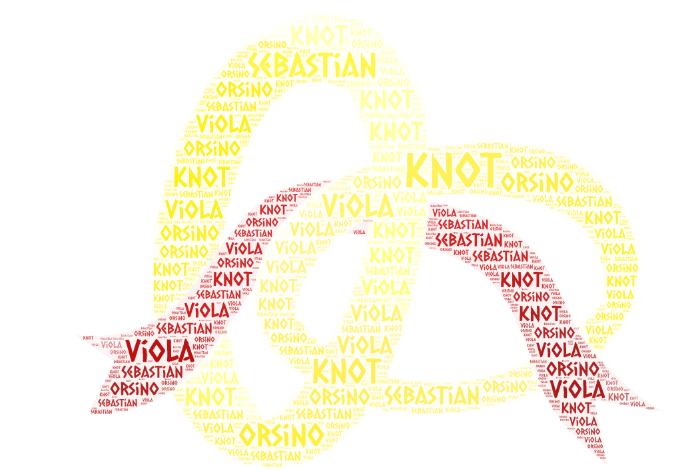
The main image here is the image of the knot- a central image of how convoluted this love triangle is.

Verse

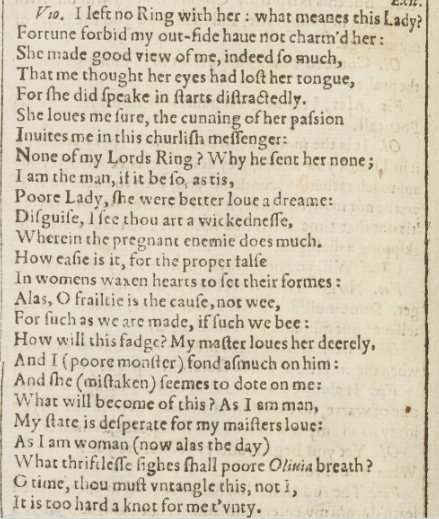
First Folio Reprint from The Boldlien Library.
I left no Ring with her: what meanes this Lady?
Fortune forbid my out‑side haue not charm'd her:
[650]
She made good view of me, indeed so much,
That me thought her eyes had lost her tongue,
For she did speake in starts distractedly.
She loues me sure, the cunning of her passion
Inuites me in this churlish messenger:
[655]
None of my Lords Ring? Why he sent her none;
I am the man, if it be so, as tis,
Poore Lady, she were better loue a dreame:
Disguise, I see thou art a wickednesse,
Wherein the pregnant enemie does much.
[660]
How easie is it, for the proper false
In womens waxen hearts to set their formes:
Alas, O frailtie is the cause, not wee,
For such as we are made, if such we bee:
How will this fadge? My master loues her deerely,
[665]
And I (poore monster) fond asmuch on him:
And she (mistaken) seemes to dote on me:
What will become of this? As I am man,
My state is desperate for my maisters loue:
As I am woman (now alas the day)
[670]
What thriftlesse sighes shall poore Oliuia breath?
O time, thou must vntangle this, not I,
It is too hard a knot for me t'vnty.

It’s interesting to note that (in the First Folio text), the verse alternates between being regular, and using a run-on technique called enjabment, where the thoughts continue after the end of the lines, starting with lines three and four. Ironically, when Viola says that Olivia was distracted and confused when she visited her, her own thoughts are disjointed and fragmentary as she reaches the inevitable conclusion that Olivia is infatuated with Viola in her disguise.

Viola’s Emotional Journey

In the book “Shakespeare’s First Texts” by Neil Freeman he describes how the Folio prints the speech in four distinct sections. Freeman hypothesizes that Shakespeare organized this speech into four phrases that chart the stages of emotions Viola goes through:

Each stage has its own easily identifiable quality, reflecting the growing steps of Viola’s journey in what for her is a huge struggle not only to comprehend, but also to deal with the enormous complications of the dreadful love triangle- the potential results of which are now becomming only too clear.

Freeman, 175.

Stage 1: Introduction

In the first three and a half sentences, Viola goes through the facts- she gave no ring to Olivia, Olivia was eying her, and half paying attention to what Viola was saying. The phrase ends with Viola’s conclusion that Olivia must be in love with her.

Stage 2: Complications

The sentences are of very irregular length- sometimes six words per line, sometimes a few as four. According to Freeman, the irregularity of the verse shows how Viola’s emotions are getting the better of her. Viola could be gasping with remorse over the pain she’s caused Olivia, or shocked at how easily she was taken in by Viola’s disguise.

Stage 3: Crisis/ Catharsis

Each line of this section mentions the people in this love triagle: “My master,” “And I,” “And She,” etc. Viola might be thinking about the possible outcomes to this situation- getting fired, getting discovered, getting married, etc.

Stage 4: Summary: “O Time, Thou Must Untangle This, Not I.”

Like Hamlet before her and Macbeth after her, Viola ends her soliloquy by saying she has no conclusion. She has no idea how to solve this problem, but can only hope that Time will provide a solution.

Audience Interaction

As I said, this is a soliloquy, which is to say, a speech where the character is solo or alone onstage. Some people think this means that the characters are talking to themselves, but I firmly disagree with this notion. One reason why Shakespeare writes soliloquies is because they allow a character to share their thoughts and feelings with the audience. They are the ancestors of every aria or solo in opera and musical theater, and every Disney Princess/ Villain song. I’ve even said before that there are some similarities between Viola and a famous Disney Princess:

Resources:

Illustrations

Ira Aldridge: Actor and Abolitionist

Happy Black History Month Everyone! Today I’m paying tribute to a great actor and activist, Mr. Ira Aldridge (1807-1867).

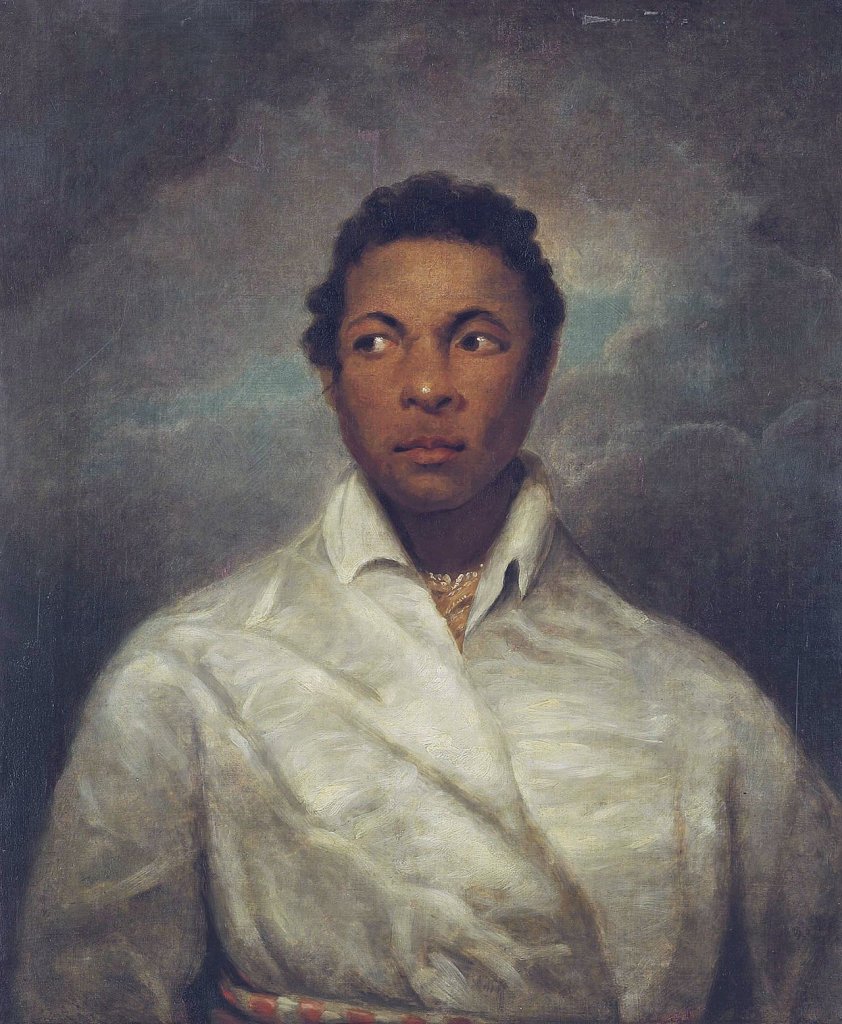
Ira Aldridge portrait by James Northcote

Mr Ira Aldridge was not only a great actor but also an influential figure in the abolitionist movement. He rose from the depths of discrimination and dehumanization to become a famous, respected international actor. Furthermore, his life was marked by creating new opportunities for himself and other people of color.

Mr. Aldridge as Othello.

Who Was Ira Aldridge?

Early Life

 True feeling and just expression are not confined to any clime or colour. 

Ira Adridge

Born in New York in 1807, Mr. Aldridge had dreams to found an all-black theater even as a teenager.  His first job was with William Brown’s African Theatre, the first African American theater company. However, discrimination and racism blocked Mr. Aldridge from success in New York, when another theater manager “hired thugs to beat up the actors”. The theatre subsequently burned down and the actors were abused by the New York police. Undaunted, Aldridge decided to take his talents to England, boarding a ship, and arriving in the early 1820s. (Howard, qtd in Thorpe 1). Even though he faced discrimination and violence as a child, Mr. Aldridge would not be deterred. Soon his skill as a Shakespearean actor would soon command respect from all.3.) He refused to be defined by the color of his skin, but by his skill as an actor.

Success In Shakespeare

Ira Aldridge as Aaron in “Titus Andronicus”

In order to become a professional actor, Ira Aldridge boarded a ship to London and became a Shakespearean actor in the early 1820s. He not only became the first black actor to play the role of Othello, he also played other roles such as Shylock in The Merchant of Venice, Gambia in The Slave, and other roles that denounced the evils of slavery:

Aldridge chose to play a lot of anti-slavery roles, including Othello, as well as the standard lead parts in the repertoire,” said Tony Howard, professor of English at Warwick University.

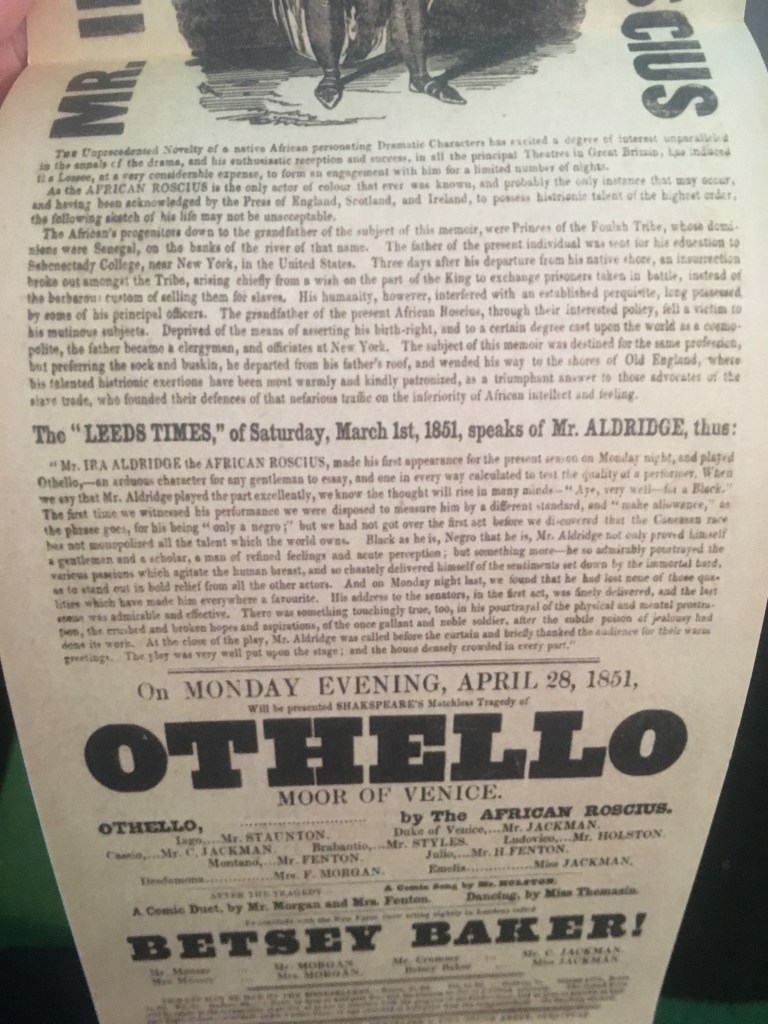
Not only did his performances call attention to the evils of slavery, they also challenged preconceived notions of what black people were capable of. As you can see in this reproduction of Mr. Aldridge’s 1851 tour advertisements, Ira Aldridge chose to bill himself as “The African Roscius,” a reference to an ancient Roman actor. His performances were heralded for his poise and dignity. The Leeds Times highlights “The passions he admirably portrayed in the human breast.”

No sooner did the Moor make his appearance, than I felt myself, I confess it, instantly subjugated, not by the terrible and menacing look of the hero, but by the  naturalness, calm dignity, and by the stamp of power and force that he manifested.

Ira Aldridge

 From 1820 to his death in 1867, Mr. Aldridge toured more than 250 theatres across Britain and Ireland, and more than 225 theatres in Europe. Though he had much more success in Europe, Mr. Aldridge still had to confront prejudices. According to ArtUK.org:

One scathing (and racist) review for The Times claimed that: ‘His figure is unlucky for the stage; he is baker-knee’d and narrow-chested; and owing to the shape of his lips it is utterly impossible for him to pronounce English in such a manner as to satisfy even the fastidious ears of the gallery.’

https://artuk.org/discover/stories/ira-aldridge-a-brief-visual-history-of-the-black-shakespearean-actor

https://witf.pbslearningmedia.org/resource/shak15.ela.lit.racism/casting-othello-why-is-racism-part-of-the-plays-history-shakespeare-uncovered/

Thus, Aldridge’s performances confronted and challenged racist views of whether or not a real black person could play Othello, subtly changing the hearts and minds of the European public, at a time when the question of slavery threatened to rip Europe, (and later the United States) apart.

Abolitionism

Although Aldridge didn’t arrive in Britain with the sole purpose of promoting the abolitionist movement, his impressive skill, charisma and oratory capabilities inevitably swayed public opinion. He became known for directly addressing the audience about the injustices of slavery on the closing night of his play at a given theatre (Source: https://artuk.org/discover/stories/ira-aldridge-a-brief-visual-history-of-the-black-shakespearean-actor )

As I’ve written before, Shakespeare has a complicated relationship with the American Civil War, and ironically, many people in the Civil War were Shakespearean actors. More importantly, England at this time was deeply divided about whether or not to support the Union or the Confederacy. England was embroiled in the cotton trade with America, and thus had an economic incentive to support the South. At the same time, public opinion was very much against slavery at the time, and Aldridge helped keep England’s public within that mindset.

Ira Aldridge cared about abolitionism and making life better for black people, especially actors. Not only did he speak out against slavery onstage, he also helped change hearts and minds in local communities. According to ArtUK, in 1828, Mr. Aldridge was approached by Sir Skears Rew to become the new manager of the Coventry Theater. He was the first black man to manage an English theater. Aldridge became a beloved member of the community of Coventry and may have helped inspire the community to petition Parliament to abolish slavery. EThus, Mr. Aldridge’s success in Europe helped open doors for European black actors and encouraged the abolitionist movement, while his sympathetic portrayals of former slaves and oppressed peoples helped change hearts and minds.

Aldridge’s Influence Today

“Aldridge has always interested black stars, but the wider influence he had is not well known,” said Howard. “Robeson was a great fan of his, and when he came to London to play Othello in 1930 at the Savoy, he put on an exhibition about Aldridge in respect of his memory.”

Vanessa Thorpe: “From 19th-century black pioneer to cultural ambassador of Coventry.” The Guardian, November 12th, 2016. https://www.theguardian.com/uk-news/2016/nov/13/black-theatre-ira-aldridge-coventry-slavery 

For nearly 100 years, actors and devotees of Mr. Aldridge have been inspired by his life. As the quote above indicates, the next great American Shakespearean Paul Robeson helped build his career on Aldridge’s success; being the first black man to play Othello on the American stage, and eventually touring Europe himself as an actor and a distinguished opera singer. Click below to read more about how Aldridge inspired generations of black actors, and his tours helped bring Shakespeare to many previously unknown European countries.

https://www.shakespeare.org.uk/explore-shakespeare/blogs/legacy-ira-aldridge/

In modern films and plays, Mr. Aldridge is remembered as a hero, and rightfully so. In the play “Red Velvet,” actor Adrian Lester plays Aldridge and highlights his struggles and successful contributions to the theatre. He was not only a great actor but a dignified and courageous champion of the rights of all people. I’m proud to conclude my black history month posts with this review of the life and career of a man who inspires all Shakespeareans and turned his profession into a powerful call for change.

Sources:

Stratford-upon-Avon’s first Black Othellos

https://www.folger.edu/blogs/shakespeare-and-beyond/ira-aldridge/

https://www.chicagoshakes.com/education/teaching_resources/teacher_handbooks/red_velvet/ira_aldridge

https://artuk.org/discover/stories/ira-aldridge-a-brief-visual-history-of-the-black-shakespearean-actor

Close Reading: Lady Macbeth “Come You Spirits.”

For commentary: http://www.bbc.co.uk/arts/yourpaintings/paintings/ideal-portrait-of-lady-macbeth-97937

For the final class of my course on Shakespeare’s Tragedies, I’m coaching two young actors on a pair of tragic speeches I’ve selected, and I thought I’d share some of that work with you. The first is a speech by Lady Macbeth that comes from Act I, Scene v. In this speech, Lady Macbeth prays to dark spirits to make her cold and remorseless, so that she can convince her husband to kill the king, and take the throne.

The Text

Lady Macbeth
The raven himself is hoarse
That croaks the fatal entrance of Duncan
Under my battlements. Come, you spirits390
That tend on mortal thoughts, unsex me here,
And fill me from the crown to the toe top-full
Of direst cruelty! make thick my blood;
Stop up the access and passage to remorse,
That no compunctious visitings of nature395
Shake my fell purpose, nor keep peace between
The effect and it! Come to my woman’s breasts,
And take my milk for gall, you murdering ministers,
Wherever in your sightless substances
You wait on nature’s mischief! Come, thick night,400
And pall thee in the dunnest smoke of hell,
That my keen knife see not the wound it makes,
Nor heaven peep through the blanket of the dark,
To cry ‘Hold, hold!’ Macbeth, Act I, Scene v, Lines 388-403.

The Given Circumstances

Lady Macbeth has just received a letter from her husband. That letter informs her the witches prophesied he would be king. Soon after she’s finished reading it, another messenger, (hoarse and out of breath), tells her that King Duncan will be staying at her castle tonight! Lady Macbeth immediately sees this as the perfect opportunity to make her husband king, by plotting to murder Duncan as he sleeps under her roof.

Traditional Interpretations

I’ve seen at least six productions of “Macbeth” and when it comes to this scene I think the main interpretations I see are either that Lady Macbeth is gleefully evil, or highly sexual. While it is true that she is praying to dark spirits, and her language when she speaks to Macbeth is sexually charged, I feel that these are not the only options when playing this character.

Francis McDormad

I love the regal poise of Francis in this 2021 movie. She is utterly in control and has absolutely no qualms about murder. I get the sense that she’s more praying to Mercury to get her to speak daggers to her husband, instead of to Lucifer to help her use one. She even has knives coming out of her ears (look at those earings!) This Lady Macbeth doesn’t seem evil in the sense of a cartoon villain. She’s just a woman in a violent society who believes that regicide is an acceptable way to sieze power. I think in this world, might makes right.

By contrast, Judy Dench in the 1979 RSC production is also very human. Her spirits are like… well spirits. You get the sense that she’s taking a swig of liquid courage to get her to go through with these actions which SHE KNOWS ARE WRONG.

Literary Devices

Imagery

“The Triple Hecate,” by William Blake, 1794.

Ravens in Greek and Norse myths were birds of prophecy and associated with the goddess of magic, Hecate (who appears in the play in Act IV). Ravens often appeared to announce deaths or execution. The speech is also full of imagery that rejects traditionally ‘feminine’ virtues. Lady Macbeth seems to associate womanhood with kindness, mercy, pity, and remorse and thus attempts to shed her femininity to accomplish her cruel objective of killing Duncan.

Verse

The Rauen himselfe is hoarse,
That croakes the fatall entrance of Duncan
Vnder my Battlements. Come you Spirits,
That tend on mortall thoughts, vnsex me here,
And fill me from the Crowne to the Toe, top-full
Of direst Crueltie: make thick my blood,
Stop vp th'accesse, and passage to Remorse,
That no compunctious visitings of Nature
Shake my fell purpose, nor keepe peace betweene
Th'effect, and hit. Come to my Womans Brests,
And take my Milke for Gall, you murth'ring Ministers,
Where-euer, in your sightlesse substances,
You wait on Natures Mischiefe. Come thick Night,
And pall thee in the dunnest smoake of Hell,
That my keene Knife see not the Wound it makes,
Nor Heauen peepe through the Blanket of the darke,
To cry, hold, hold. Macbeth, Act I, Scene v, First Folio Reprint from Internet Shakespeare Editions.

It’s interesting to note that (in the First Folio text) this speech is only three sentences long. It is a constant build up of energy with only three stops. In addition, Shakespeare puts the most important words, at the end of each line. Almost every line ends with something Lady M wants to kill, such as Duncan, or wants to kill within herself (peace, remorse, nature, Woman(hood). The verse also has commands strewn about in the beginnings and ends of lines. The question is, how confident does Lady Macbeth feel while giving them?

Questions to consider

One of the biggest questions I have with this play is why Lady Macbeth and her husband want to be king and queen anyway? After all, Shakespeare has written plenty of plays that detail how hard and stressful (uneasy) it is to be king. Plus, Macbeth is already a trusted lord and friend of the king, why would he want to damn himself to get a job he knows isn’t his to take? I think that, especially now in the 21st century, it’s very important to have a coherent motive for why the Macbeths are willing to kill for the crown.

Our Interpretation

Looking over the text, my actress sensed a deep loneliness in Lady Macbeth and a haunted feeling that makes her seem desperate to change her life. I thought about how insomnia and paranoid fears are repeated motifs in the play, as well as character traits found in both Macbeth and later Lady Macbeth. Then I thought- Macbeth is a soldier; his wife has probably had to spend years wondering if he is going to come home and imagining what kind of terrible death he might suffer on the battlefield While the king sits safely at home. Perhaps she sees killing the king as a form of revenge for all the fear and sleepless nights she’s experienced, and an attempt to protect her husband from war, by safely placing him on the throne. Maybe she sees this as the only way to make sure her beloved husband never dies in battle. Therefore, instead of watching an evil woman become more evil, you’re watching a good woman, (with good intentions), damn herself for love, which I would argue is a much more active and dynamic choice.

Resources:

https://myshakespeare.com/macbeth/act-1-scene-5

Happy Twelfth Day of Christmas Everyone!

Hello everyone! I’m back from break and happy to celebrate one of my favorite holidays with you- the one that gave its name to one of Shakespeare’s greatest comedies- Twelfth Night

How to throw a Twelfth Night Party

How To Throw A Twelfth Night Party

How to Make a Twelfth Night Cake

Intro to Twelfth Night (THe play)

I’ve been in this play three times and I’m continually struck by how fun, romantic, and progressive it is. It raises questions about gender roles, social norms, bullying, and even catfishing and heteronormativity! It’s a fascinating and thought-provoking play and it’s my favorite of Shakespeare’s comedies!

Shakespeare’s early comedies are about young love, infatuation, and being ‘madly in love’ (sometimes literally). His middle plays are about mature relationships between men and women and the need for commitment. I would argue that Twelfth Night, (and possibly Much Ado About Nothing), are the best examples of Shakespeare telling meaningful stories about romantic relationships.

Past Posts on “Twelfth Night”

  1. Play of the Month: Twelfth Night
  2. The Fashion Is the Fashion: Twelfth Night
  3. Crafting a Character: Malvolio
  4. Exquisite Artwork from Twelfth Night

Would you like to know more? Take a class!

In honor of “Twelfth Night,” I’ve created a coupon for my course on Shakespeare’s comedies from now till January 31st: Get $10 off my class “Shakespeare’s Comic Plays” with coupon code HTHESYTIT110 until Jan 31, 2023. Get started at https://outschool.com/classes/shakespeares-comic-plays-868BR5hg and enter the coupon code at checkout.

To finish I wanted to give you a complete production of Twelfth Night for your viewing pleasure, but I can’t decide which one, so I will post a bunch today! 

1. 1996 TV movie starring Geoffrey Rush (Pirates of the Caribbean)

2.1996 Thames TV directed by Kenneth Branaugh