
Now a bit of poetry, here’s Sonnet 116 in Gaelic, the ancient language of Ireland:
And finally, here’s a post about Shakespeare’s Irish connection from the Irish Times:


Now a bit of poetry, here’s Sonnet 116 in Gaelic, the ancient language of Ireland:
And finally, here’s a post about Shakespeare’s Irish connection from the Irish Times:
https://www.theguardian.com/culture/2022/feb/13/rotten-state-of-hamlet-analysis
What do you think? Is she right and Hamlet is a simple play that’s been made complicated by time, or is there something deeper that she’s misses.
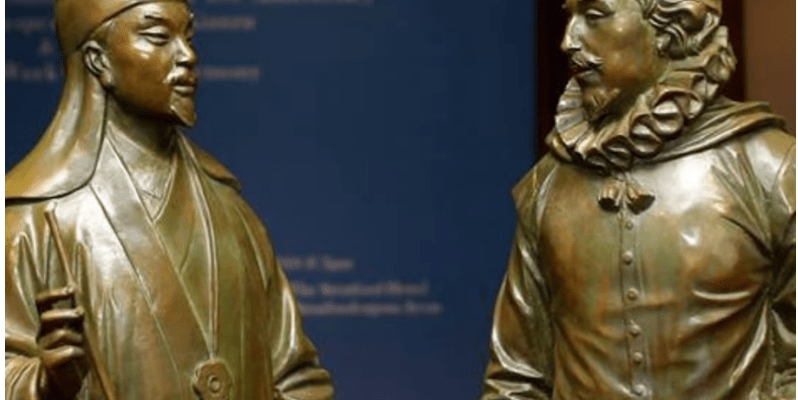
Happy Chinese New Year Everyone!
As I said in my “Is Shakespeare Being Cancelled?” post, there is a long tradition of using Shakespeare as the epitome of creative arts, especially in England. For centuries, British imperialists have justified their subjugation of other cultures by claiming that English culture is superior, and Shakespeare became an unknowing cog in the machinery of cultural imperialism.
Since it is pretty much impossible to de-throne Shakespeare, one response that other cultures have used is to elevate their own artists to Shakespearean status. People are already calling Lin-Manuel Miranda the American Shakespeare, and there have been many other Shakespeares around the globe (Feng). Thre’s nothing wrong with this; after all, every culture has its own cultural heroes and they help embody what is important to that culture, which is why it’s fascinating to ponder the question- what makes someone The Chinese Shakespeare?
One other response to cultural imperialism is of course, to reject it, and since its inception, the Communist Party has sought to exclude, belittle, and suppress access to Western imperialist art. Shakespeare was banned during the Cultural Revolution of the 1960s, and even today the Communist Party is quicker to praise Chinese artists as being “Shakespearean,” than to praise Shakespeare directly. Just last year, President Xi Xinping officially declared that poet Tang Xianzu was “The Chinese Shakespeare.”
To be fair, Tang XIanzu was Shakespeare’s contemporary and there are some startling similarities between the themes and ideas expressed by the two poets:
China has produced some wonderful ballets, operas, and poetry so even though the government has suppressed Shakespeare in the past, the Chinese people have expressed a love of Shakespeare for over a century. As early as 1903, Chinese intellectuals started reading and translating Shakespeare and the first Chinese adaptation of Shakspeare was a rhymed ballad version of Romeo and Juliet’s balcony scene written by Deng Yizhe in 1910 (Sun, 1932). Today productions of Shakespeare are very popular in China and Shakespeare has facilitated a fascinating cultural exchange between east and west.
In addition to Chinese students encountering Shakespeare in the classroom, and the popularity of theater productions of Shakespeare in China, there are some fascinating efforts for English and Chinese speaking audiences to use Shakespeare as a bridge to cultural understanding. Right now, plans are underway to build a replica of Shakespeare’s birthplace in the southern Chinese city of Fuzhou. Meanwhile in Stratford Upon Avon, the government of Fuzhou gave a statue of Tang Xianzu to be featured prominently in the garden of the actual Shakespeare birthplace on Henley Street (Woodings).

In addition, Royal Shakespeare Company Artistic Director Greg Doran, (former husband of the great RSC actor Antony Sher), has spearheaded a number of outreach projects designed to translate Shakespeare’s The Tempest into a format better suited for theater productions in China. The final show, which premiered in 2018, was not only a successful collaboration between east and western artist, but the production, with its themes of freedom and liberty, was likely to ruffle feathers in the Chinese government, according to (Yuan Yang).
In Xi’s closely controlled China, The Tempest’s themes of liberty and identity clearly carry political ideas at odds with the ruling party — “thought is free”, the sprite Ariel sings. The implicit challenge to the status quo extended from the ideas to the production itself at the National Centre for the Performing Arts in Beijing. It offered new freedoms to the Chinese actors from the centre’s in-house theatre ensemble. Under the guidance of director Tim Supple, this was the first time they had been invited to experiment with performance and alter the text.
Yuang Yang. “The Bard in Beijing: how Shakespeare is subverting China”
To sum up, every culture has been exposed to Shakespeare, and many have found ways to re-interpret him, appropriate him, and use him as a tool of cultural exchange. This is neither good nor bad, it just is. What is interesting is that China has taken Shakespeare from a tool of imperialism into a tool of both multiculturalism, and subversion of their government. Studying the way other China and cultures have interpreted Shakespeare is a window into the values of those cultures and thus helps to further build a global community.
Below is a scene from a Chinese opera version of Hamlet for your viewing pleasure!
Podcasts
Journals:
Yanna Sun. Shakespeare Reception in China. Theory and Practice in Language Studies, Vol. 2, No. 9, pp. 1931-1938, September 2012 © 2012 ACADEMY PUBLISHER Manufactured in Finland.
Qi-Xin He: China’s Shakespeare.
Shakespeare QuarterlyVol. 37, No. 2 (Summer, 1986), pp. 149-159 (11 pages)Published By: Oxford University Press. Retreived online from jstor.com.
Web:
Laurie Chen: China’s replica of Shakespeare’s birthplace Stratford-upon-Avon coming in 2022. South China Morning Post. Originally published October 2nd, 2018. Retrieved online from: https://www.scmp.com/news/china/society/article/2166635/work-start-soon-chinese-replica-shakespeares-birthplace-literary.
Simon Woodings: Tang Xianzu statue Unveiled at Shakespeare’s Birthplace. Stratford Upon Avon Herald. Originally published April 27th, 2017. Retrieved online from: https://www.stratford-herald.com/news/tang-xianzu-statue-unveiled-at-shakespeare-s-birthplace-9138327/
China’s Love Affair With Shakespeare Retreived 1/29/22 from https://www.barrons.com/articles/chinas-love-affair-with-shakespeare-51585137600
Yuan Yang. The Bard in Beijing: how Shakespeare is subverting China. Financial Times. October 5th, 2018. Retrieved online from https://www.ft.com/content/cd997246-c57b-11e8-bc21-54264d1c4647
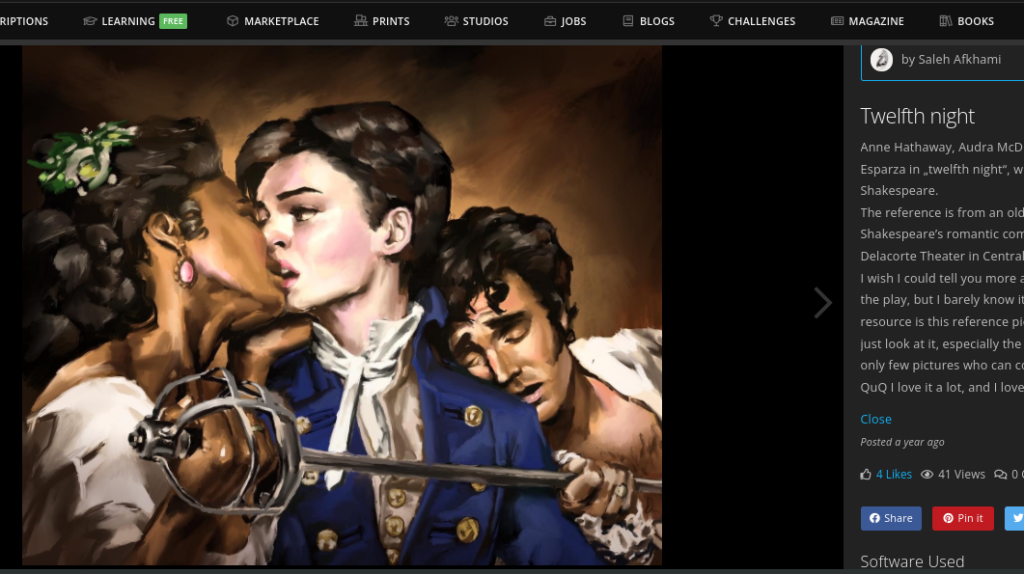
I want to give a shout-out to artist Maike Edling, who painted this beautiful rendition of Anne Hathaway (the actress, not Shakespeare’s wife), playing Viola in Twelfth Night at the Delacorte Theater in Central Park. The colors and the long brush strokes remind me of Cezanne and other early impressionists and give a kind of chaotic feel (appropriate for such a chaotic love triangle). Also, the choice to show Olivia kissing Viola while Orsino looks sadly on is not only passionate and vibrant, it sums up in one image the central conflict of the play: how will Viola deal with the fact that she loves a man, but is pursued by a woman?
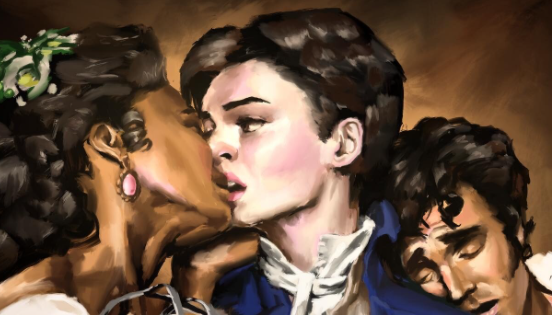
I also love the ambiguity of Viola’s expression. She’s looking at Olivia, but her lips don’t quite touch, as if she’s thinking, “This feels weird, but…” It highlights the flirtation with gender norms and questioning heteronormativity that every production of “Twelfth Night” must address. All in all, I think it is an excellent depiction of the characters, themes and ideas of “Twelfth Night,” and if you can, you should patronize her work. I found this painting at https://www.artstation.com/artwork/ELEEAv, and I think it should get more views.
I’m very excited! As some of you know, I wrote a piece about Orson Well’s 1936 Federal Theater Project production of “Macbeth,” set in Haiti. This was an important moment in theater history, and helped keep theater and African Americans employed during the Great Depression, so it deserves to be remembered. Imagine my joy when I found out that there’s an independent movie about the creation of this show! Below is the trailer. If you go to https://www.voodoomacbethfilm.com/, you can see the screening dates. Check it out when it comes to your town!

What do you think of when you think of “Shakespeare?” What do you think of when you think of “A Midsummer Night’s Dream?”
Ruffs and Tights?
Mostly white dudes?
Elizabethan music?
Dark night and moon?

This production, directed by Michelle Terry, is gleefully throwing out every preconceived notion of what A Midsummer Night’s Dream can or should be. In terms of design, casting, music, and interpretation, it breaks all the rules, while still remaining true to the text. This allows the production to appeal to not only hard-core Shakespeare fans, but first time audiences and children too!


I got to see this production thanks to the Globe’s online streaming library. My mother kindly shared me a link to this recording from the summer of 2021. You can watch it yourself on: https://www.shakespearesglobe.com/watch/#full-length-productions
I would describe the concept behind the show as “Suggestive,” that is, it doesn’t belong to a literal time and place. Even though the play is set in Ancient Greece, the play refuses to be constrained by historical accuracy, which arguably, fits nicely with Shakespeare in particular, and the Globe itself; a modern building in a modern city, based on a 400-year-old building.
The music and costumes evoke a New Orleans Mardis Gras, a Pride parade, or a Spanish pinata with its bright colors, heavy use of fringes, and bright, energetic jazz music. The only people who don’t wear bright colors are the four lovers, which reflects their continuous frustration with being unable to marry the person they really want.

The show is also Color blind and gender blind, with women playing men’s parts and a cast with black, white, and mixed race actors. Terry’s direction also calls attention to the patriarchial, racist, and sexist elements of Athens which are often overlooked in other interpretations of Dream that I’ve seen or read about. Rather than being a hero, Theseus is a horny old man in a ludicrous pink uniform, looking like a cross between M. Bison and a Christmas nutcracker. To reinforce this point, the actor chose to perform one of Theseus’ most patriarchial speeches as a joke:
Theseus. What say you, Hermia? be advised fair maid:50
To you your father should be as a god;
One that composed your beauties, yea, and one
To whom you are but as a form in wax
By him imprinted and within his power
To leave the figure or disfigure it. -Midsummer Night's Dream, Act I, Scene i.
I’ve seen this speech heavily cut and played seriously, but never till now did I see it played to ridicule the ludicrous notion that women are in any way bound to worship their fathers.
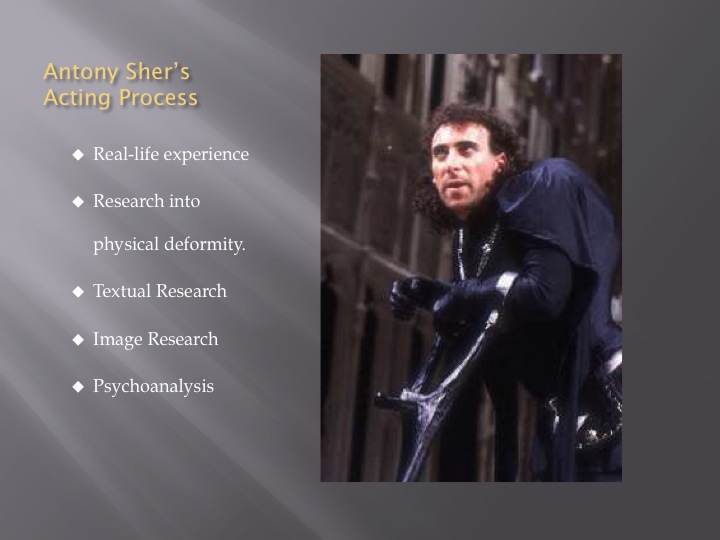
In another nod to contemporary gender politics, the actress who plays Hippolyta and Titania chose to perform her role on crutches. As far as I can tell, this was a deliberate choice and not a result of real injury. There is a precedent for this: In 1984, Sir Antony Sher performed Richard iii on crutches because it highlighted the cruelty people with disabilities often suffer.
I could be wrong, but I think that the reason the actress was on crutches was a symbolic way of confronting the way gender politics can cripple women.
Many scholars have pointed out how Hippolyta rarely speaks despite the fact that she is supposed to be the powerful Queen of the Amazons, and Theseus’ fiance besides. Shakespeare makes it clear that their marriage was arranged as a political alliance after the Amazons lost to Athens in a war:
Hippolyta, I woo'd thee with my sword,
And won thy love, doing thee injuries;20
But I will wed thee in another key,
With pomp, with triumph and with revelling.
With this in mind, it makes sense to have Hippolyta on crutches as a result of her injuries. Those injuries might also explain her silence; she has lost her agency now that she is essentially Theseus’ prisoner. One might think of any number of war atrocious where women have been sold to powerful men over the centuries. In short, by putting Hippolyta on crutches, we see a glimpse into her tragic story that most productions just gloss over- that she has lost a war, been separated from her people, and is now her enemies’ prisoner through marriage.
I’ve come to expect high quality acting from The Globe Theater Company and this cast did not disappoint. As we watched it together, my family concluded that this was one of the best acted productions of Dream that we’ve ever seen, which between us has to be over 30 plus productions.
The delivery is crisp and fast paced. Every actor has taken these words and made them their own. They speak them as if they were written yesterday. One thing I love about the Globe is that the directors encourage this kind of fast paced delivery; with no distracting special effects or sets, the actors have to captivate the audience with their delivery of Shakespeare’s text, without being melodramatic or self-indulgent. I’m pleased to say that this cast does a fantastic job of telling this magical story in a compelling and very modern way.
I’ve shown my recording to kids, teens, adults, and my family, and everyone has a different reaction to the show. Maybe this isn’t quite your cup of tea, but the concept is sound, the acting is high caliber, and it utilizes the Globe’s unique qualities extremely well.
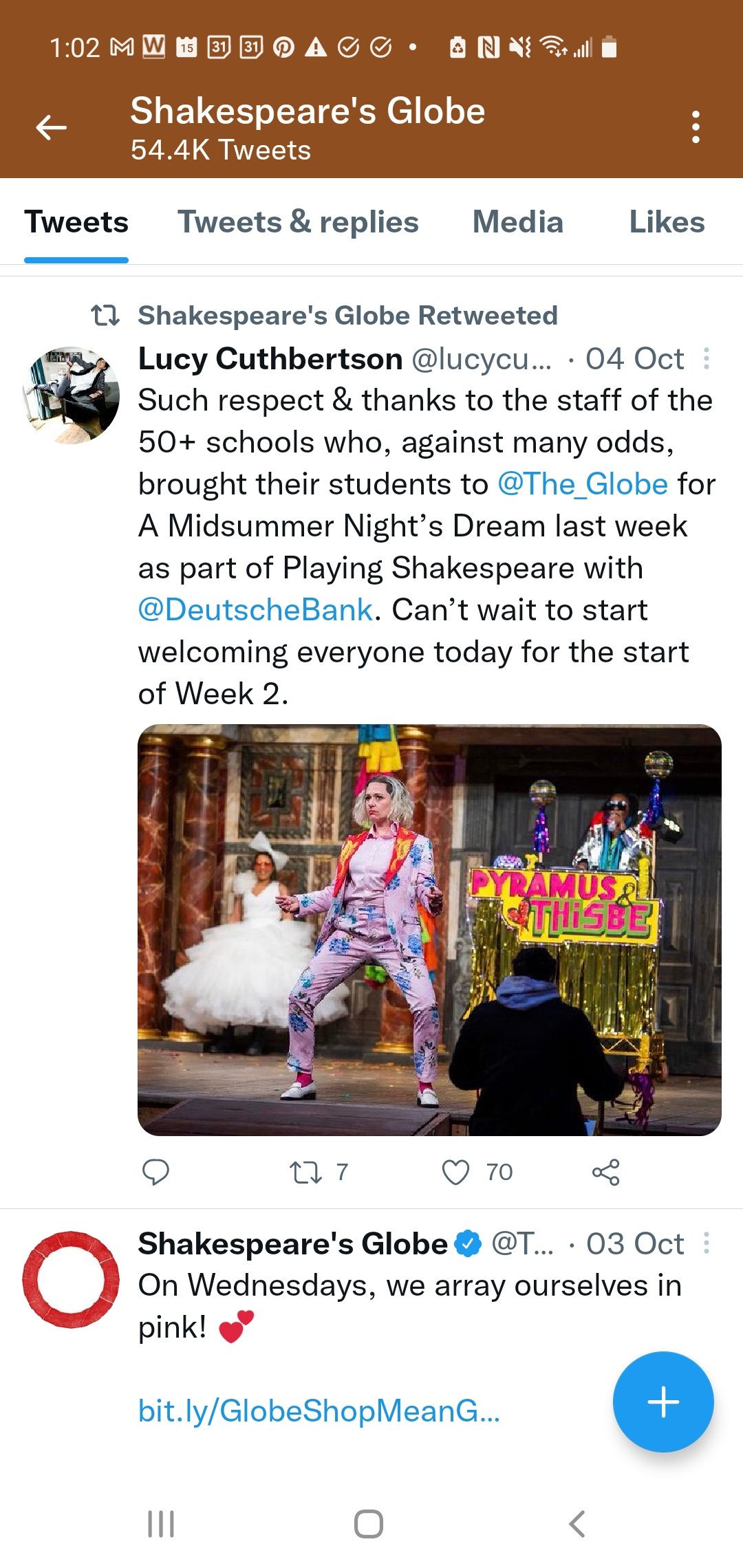
I personally didn’t care for Bottom just because I felt the actress was playing a very energetic part with too much sarcasm and tongue in cheek, but that’s mostly personal preference. I did however love Peter Quince, Snout, Snug, and the rest of the Mechanicals. Peter Quince is a rather thankless part but it’s great to see someone balance being a straight man trying to reign in Bottom’s antics. and an idiot who has no idea how to direct a company of actors, which the actress playing Quince did very well.

This video is part of my Outschool course “Macbeth: An Immersive Horror Experience.” I use it to explain the plot of the play before playing a game and an escape room to test the student’s knowledge. Let me know in the comments what you think of it, and if you like it, please consider signing up for the course on Outschool.com

I’ve been working on a remote learning class for Outschool.com where I take some of the audition advice I wrote in Creating A Character: Macbeth, and some of the other acting posts I’ve published over the years. This will be a weekly virtual acting course for kids ages 13-18, starting September 12th at 10AM EST.
This class will outline the tools and techniques of Shakespearean acting such as projection, articulation, and imagination. Each We’ll also go over Shakespeare’s own advice on acting in his play “Hamlet: Prince of Denmark.” The course will culminate with the students choosing their own Shakespearean monologues and scenes, which they can use going forward in auditions, school plays, and classes.
The best thing about the course is that each week builds on the previous week’s experience, but you don’t need to go to all of them. I’ll be flexible and work with the student’s schedule so everyone gets as much out of the class as possible.
If you’re interested in signing up, go to Outschool.com. If you have any questions, email me by clicking here:
Hope to see you online soon!

As you probably know if you subscribe to this blog, I love to review adaptations of Shakespeare, so imagine my delight when I realized that the classic teen comedy Mean Girls from 2004, (and the current Broadway show of the same name), is based on Julius Caesar! This movie doesn’t have Shakespearean dialogue or the names or locations, but the essence of the play is the same, albeit with a more modern ending.
In Shakespeare’s play and Tina Fey’s script, the main antagonist is popular, and dangerous, and inspires fear and envy from everyone. Regina George and Caesar both rule their empires through their armies, intimidation, their wealth, and their supreme self-confidence. In addition, both names are associated with royalty- Regina in Latin means queen.

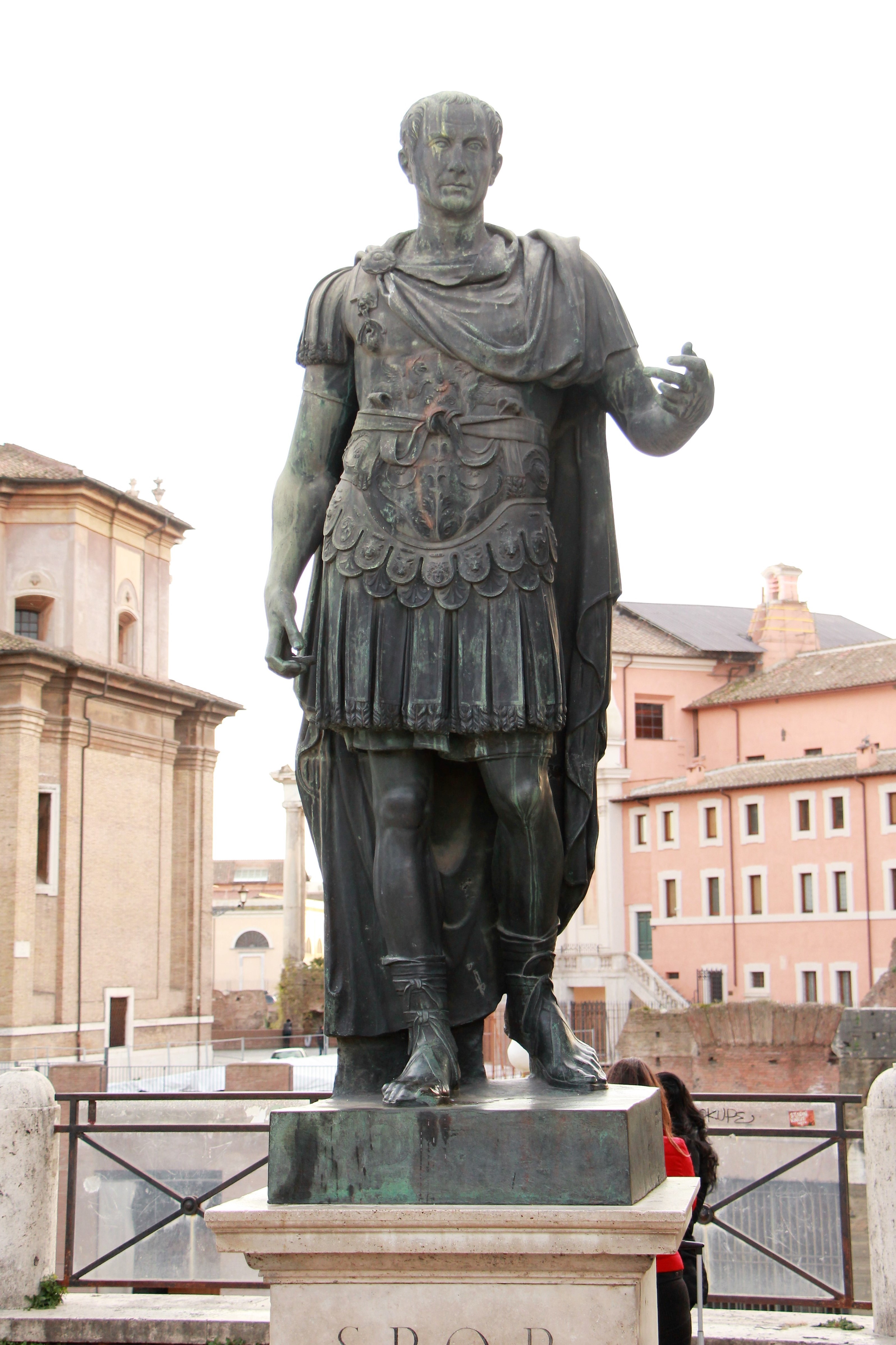
I didn’t realize that the movie has its roots in Julius Caesar until I saw this video from the YouTube channel The Take: https://youtu.be/FRfoEzZbK_Y. It was when I watched this video, that I realized Mean Girls character Janis was an analog for Shakespeare’s character Cassius, the man who sets the plot in motion to assassinate Caesar.
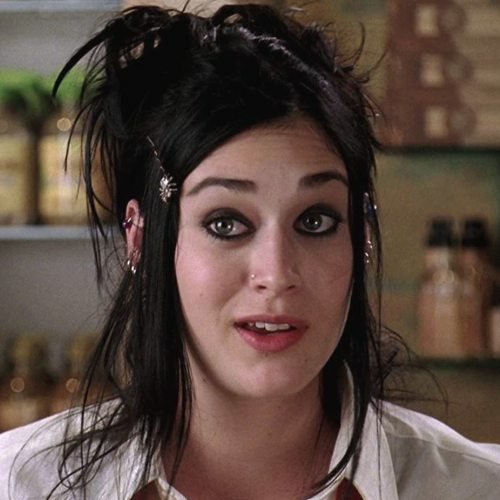
In the movie, Janis meets a well meaning girl and manipulates her into betraying Regina. Look at this clip where after Cady feels betrayed by Regina, Janis outlines her conspiracy, with a Roman sword in her hand! https://youtu.be/D0JMoa4QfA0

Like Cassius, Janis claims that once Regina is destroyed, the social order of the high school will change from a dictatorship to a democracy, but what she really wants is to supplant and replace Regina and make herself the new queen Bee. Even her name is a clue to her malevolent nature, she is named after the Roman god with two faces!

Sir Patrick Stewart as Cassius in the 1972 RSC production of Caesar
Similarly in Julius Caesar, Cassius convinces Brutus that once Caesar dies, Rome will be a republic again. In real life, Brutus was Caesar’s close friend, so Brutus agonizes over whether he is doing the right thing and whether he owes more loyalty to Rome, or his friend Caesar: https://youtu.be/IoDwXjKIenI
If Janis is Cassius, what about Brutus?

Cady Heron (played in the movie by Lindsay Lohan), is naive but intelligent. Like Brutus, she is manipulated and carefully chosen to betray the king. Janis chooses Cady because she’s pretty enough to get close to Regina, her looks are like social currency. Brutus’ social currency was his family: he was descended from the founder of the republic so he lent credibility to the conspiracy. He was also close in family to Caesar and Cassius.

In both stories once the monarch is destroyed, the power vacuum immediately starts to close; rather than change the social order, a new monarch arises. In Caesar, the second triumvirate takes over for the first, and Caesar’s nephew Augustus eventually becomes the supreme ruler of the Roman empire.

In Mean Girls, once Regina loses her social cache, Cady takes her place.
Then when Janis exposes Cady and Regina, she briefly basks in becoming a new Queen Bee- her revolution to overthrow a tyrant has paid off, bit now she is the tyrant herself. This actually mirrors the real Julius Caesar, who took power from the feared dictator Lucius Cornelius Sulla.

Bust of Sulla
Like Regina and her Burn Book, Sulla kept a list of people he saw as threats called the Proscriptions, only Sulla used it to execute the people on the list and seize their property. Caesar started his career as a populist soldier working for the Senate against Sulla and for the people, but became a dictator himself, the very thing he was sworn to oppose!
The movie does end on an encouraging note when the adults finally step up and address the terrible things that their students are doing, which has important lessons about bullying that every young person should see.

Tina Fey actually admitted that she herself was a Mean Girl in high school, so there’s a great deal of honesty when her character confronts the kids about the consequences of bullying each other.
Though the movie ends happily, the Cesarian parallels are not over; even though this high school has been democratized, the problems that created this Mean Girls autocracy remains. As you can see in the final minutes of the movie, a new crop of Plastics arrive just as the old group disbanded.https://youtu.be/LshX2God-wkIn four years when the regime changes again, will there be a new Caesar?
After rewatching clips from the movie, I realized that Tina Fey actually made a Caesar reference right there in the movie!
In this clip, Gretchen is in English class, perfectly paraphrasing Cassius’ speech in Act I, Scene ii, even the part about Caesar being a colossus:
Cassius. Why, man, he doth bestride the narrow world
Like a Colossus, and we petty men
Walk under his huge legs and peep about
To find ourselves dishonourable graves.
Brutus and Caesar: what should be in that ‘Caesar’?
Why should that name be sounded more than yours?
Write them together, yours is as fair a name;
Sound them, it doth become the mouth as well;
Weigh them, it is as heavy; conjure with ’em,
Brutus will start a spirit as soon as Caesar.
Now, in the names of all the gods at once,
Upon what meat doth this our Caesar feed,
That he is grown so great? Age, thou art shamed!
Rome, thou hast lost the breed of noble bloods!
When went there by an age, since the great flood,
But it was famed with more than with one man?
When could they say till now, that talk’d of Rome,
That her wide walls encompass’d but one man?
Now is it Rome indeed and room enough,
When there is in it but one only man.
O, you and I have heard our fathers say,
There was a Brutus once that would have brook’d
The eternal devil to keep his state in Rome
As easily as a king. I.ii. 226-252.
Now I know Mean Girls is based more on a book and by Tina Fey’s own experiences than Shakespeare, but the point is that the next time you are bored and angry about having to read a play based on a guy who’s been dead for over 2,000 years, take a look at the lunch table next to you and you’ll see that things haven’t changed that much.


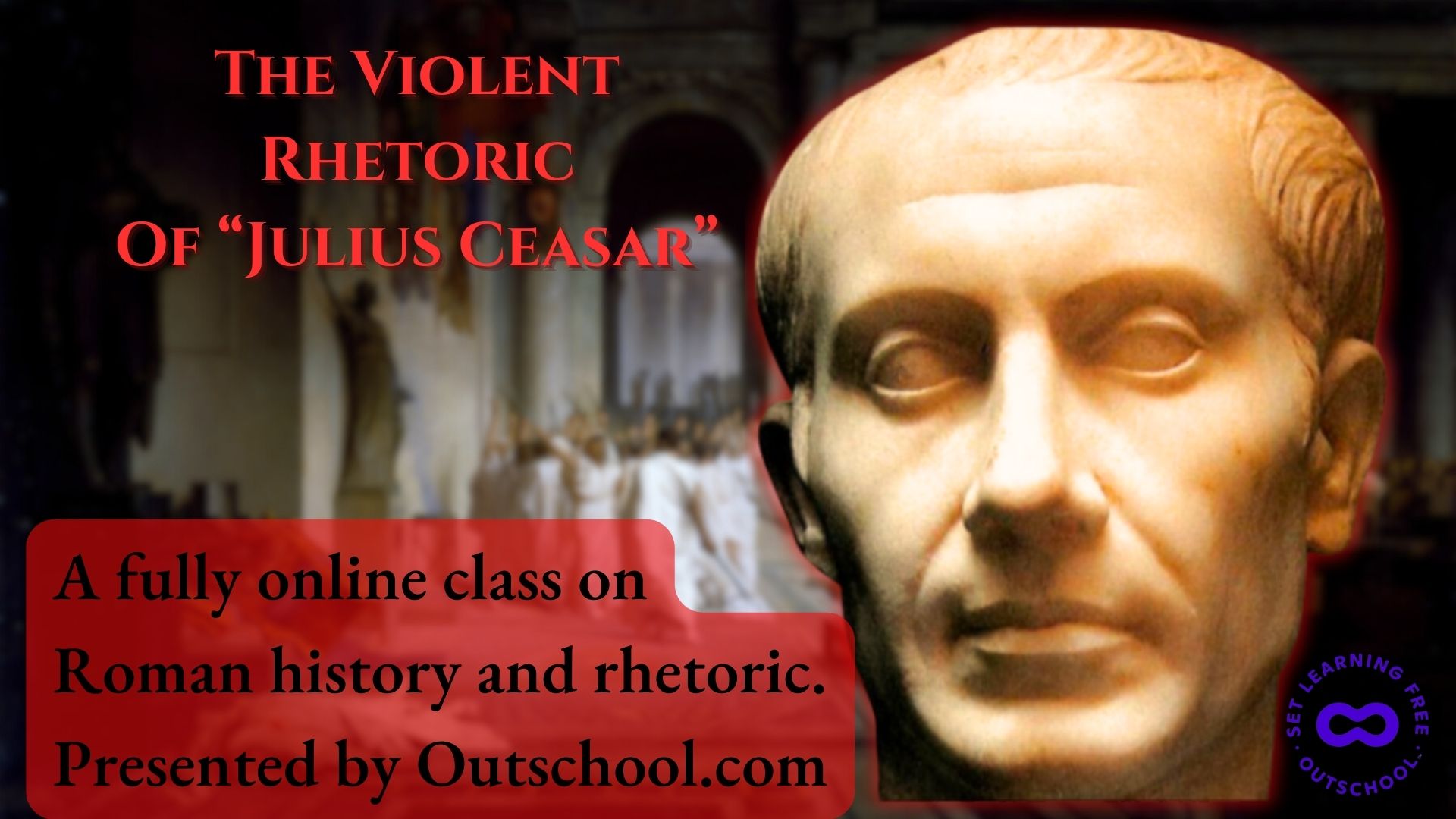
If you liked this post, please consider signing up for my online class, “The Violent Rhetoric Of Julius Caesar,”

The class breaks down some of the most famous speeches in Julius Caesar and gives you some tips and tricks on how to write persuasive speeches like Antony’s “Friends, Romans, Countrymen,” speech. Use these powers for good though, not to turn your school into a Mean Girls dictatorship! https://outschool.com/classes/84ee847d-19f3-45f8-9f25-81e688b8497d
There’s also a fully asynchronous version that you can do on your own time whenever you want:
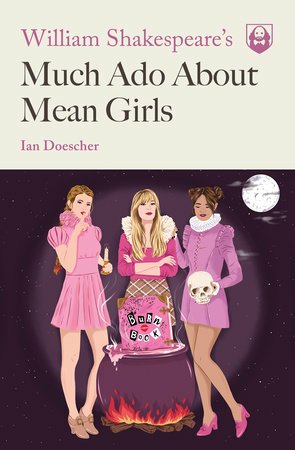
Finally, if you love Mean Girls and Shakespeare, check out Much Ado About Mean Girls by Ian Doescher, author of the William Shakespeare’s Star Wars trilogy.
 The Shakespearean Student