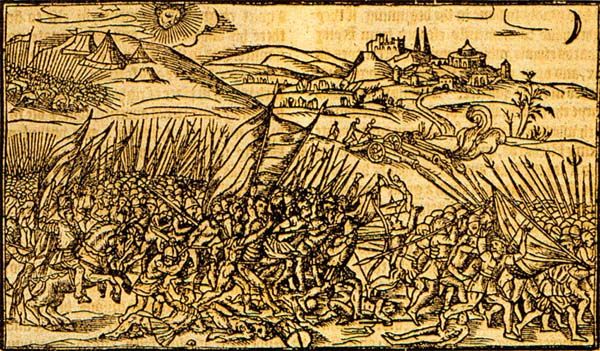
To begin wrapping up our Richard III month, I thought it might be appropriate to speak a little about the battle that ended the real Richard’s life, the Battle of Bosworth Field, August 22, 1485.
What does Shakespeare Say about the battle:
KING RICHARD III
Come, bustle, bustle; caparison my horse.
Call up Lord Stanley, bid him bring his power:
I will lead forth my soldiers to the plain,
And thus my battle shall be ordered:
My foreward shall be drawn out all in length,
Consisting equally of horse and foot;
Our archers shall be placed in the midst
John Duke of Norfolk, Thomas Earl of Surrey, Shall have the leading of this foot and horse. They thus directed, we will follow In the main battle, whose puissance on either side Shall be well winged with our chiefest horse. This, and Saint George to boot!
What think’st thou, Norfolk?
NORFOLK
A good direction, warlike sovereign.
Richard III, Act V, Scene iii.
This speech matches very well with what the chronicles mention about the battle. In those days the English archers were more deadly than their cavalry, so Richard probably wanted to pick off as many soldiers as possible with the archers, then mow the rest down with his charge toward Henry.
Contemporary Accounts, (courtesy of the Richard III Society). The most complete, and unbiased account I could find was Polydore Virgil, which is also likely the one from which Shakespeare got his information. You’ll notice that it mentions the long line of foot soldiers and horsemen, and the mention of the Duke of Norfolk commanding one of Richard’s forces.

‘The day after King Richard, well furnished in all things, drew his whole army out of their encampments, and arrayed his battle-line, extended at such a wonderful length, and composed of footmen and horsemen packed together in such a way that the mass of armed men struck terror in the hearts of the distant onlookers. In the front he placed the archers, like a most strong bulwark, appointing as their leader John, duke of Norfolk. To the rear of this long battle-line followed the king himself, with a select force of soldiers.‘Meanwhile … early in the morning [Henry Tudor] commanded his soldiery to set to arms, and at the same time sent to Thomas Stanley, who now approached the place of the fight, midway between the two armies, to come in with his forces, so that the men could be put in formation. He answered that Henry should set his own men in line, while he would be at hand with his army in proper array. Since this reply was given contrary to what was expected, and to what the opportunity of the time and greatness of the cause demanded, Henry became rather anxious and began to lose heart. Nevertheless without delay he arranged his men, from necessity, in this fashion. He drew up a simple battle-line on account of the fewness of his men. In front of the line he placed archers, putting the earl of Oxford in command; to defend it on the right wing he positioned Gilbert Talbot, and on the left wing in truth he placed John Savage. He himself, relying on the aid of Thomas Stanley, followed with one company of horsemen and a few foot-soldiers. For all in all the number of soldiers was scarcely 5,000, not counting the Stanleyites of whom about 3,000 were in the battle under the leadership of William Stanley. The king’s forces were at least twice as many.
 ‘Thus the battle-line on each side was arrayed. As soon as the two armies came within sight of each other, the soldiers donned their helms and prepared for the battle, waiting for the signal to attack with attentive ears. There was a marsh between them, which Henry deliberately left on his right, to serve his men as a defensive wall. In doing this he simultaneously put the sun behind him. The king, as soon as he saw the enemy advance past the marsh, ordered his men to charge. Suddenly raising a great shout they attacked first with arrows, and their opponents, in no wise holding back from the fight, returned the fire fiercely. When it came to close quarters, however, the dealing was done with swords.‘In the mean time the earl of Oxford, afraid that in the fighting his men would be surrounded by the multitude, gave out the order through the ranks that no soldier should go more than ten feet from the standards.

When in response to the command all the men massed together and drew back a little from the fray, their opponents, suspecting a trick, took fright and broke off from the fighting for a while. In truth many, who wished the king damned rather than saved, were not reluctant to do so, and for that reason fought less stoutly. Then the earl of Oxford on the one part, with tightly grouped units, attacked the enemy afresh, and the others in the other part pressing together in wedge formation renewed the battle.

While the battle thus raged between the front lines in both sectors, Richard learnt, first from spies, that Henry was some way off with a few armed men as his retinue, and then, as the latter drew nearer, recognised him more certainly from his standards. Inflamed with anger, he spurred his horse, and road against him from the other side, beyond the battle line. Henry saw Richard come upon him, and since all hope of safety lay in arms, he eagerly offered himself for this contest. In the first charge Richard killed several men; toppled Henry’s standard, along with the standard-bearer William Brandon; contended with John Cheney, a man of surpassing bravery, who stood in his way, and thrust him to the ground with great force; and made a path for himself through the press of steel.
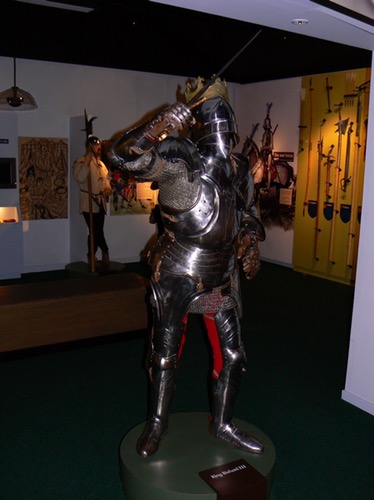
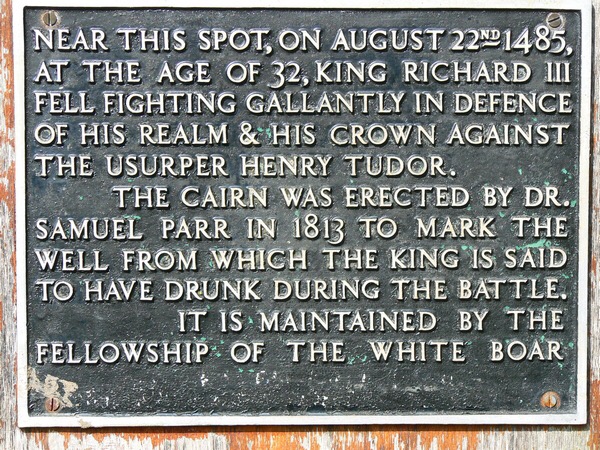
‘Nevertheless Henry held out against the attack longer than his troops, who now almost despaired of victory, had thought likely. Then, behold, William Stanley came in support with 3,000 men. Indeed it was at this point that, with the rest of his men taking to their heels, Richard was slain fighting in the thickest of the press. Meanwhile the earl of Oxford, after a brief struggle, likewise quickly put to flight the remainder of the troops who fought in the front line, a great number of whom were killed in the rout. Yet many more, who supported Richard out of fear and not out of their own will, purposely held off from the battle, and departed unharmed, as men who desired not the safety but the destruction of the prince whom they detested. About 1,000 men were slain, including from the nobility John duke of Norfolk, Walter Lord Ferrers, Robert Brackenbury, Richard Radcliffe and several others. Two days after at Leicester, William Catesby, lawyer, with a few associates, was executed. Among those that took to their heels, Francis Lord Lovell, Humphrey Stafford, with Thomas his brother, and many companions, fled into the sanctuary of St. John which is near Colchester, a town on the Essex coast. There was a huge number of captives, for when Richard was killed, all men threw down their weapons, and freely submitted themselves to Henry’s obedience, which the majority would have done at the outset, if with Richard’s scouts rushing back and forth it had been possible. Amongst them the chief was Henry earl of Northumberland and Thomas earl of Surrey. The latter was put in prison, whree he remained for a long time, the former was received in favour as a friend at heart. Henry lost in the battle scarcely a hundred soldiers, amongst whom one notable was William Brandon, who bore Henry’s battle standard. The battle was fought on the 11th day before the kalends of September, in the year of man’s salvation 1486, and the struggle lasted more than two hours.
‘The report is that Richard could have saved himself by flight. His companions, seeing from the very outset of the battle that the soldiers were wielding their arms feebly and sluggishly, and that some were secretly deserting, suspected treason, and urged him to flee. When his cause obviously began to falter, they brought him a swift horse. Yet he, who was not unaware that the people hated him, setting aside hope of all future success, allegedly replied, such was the great fierceness and force of his mind, that that very day he would make an end either of war or life. Knowing for certain that that day would either deliver him a pacified realm thenceforward or else take it away forever, he went into the fray wearing the royal crown, so that he might thereby make either a beginning or an end of his reign. Thus the miserable man suddenly had such an end as customarily befalls them that for justice, divine law and virtue substitue wilfulness, impiety and depravity. To be sure, these are far more forcible object-lessons than the voices of men to deter those persons who allow no time to pass free from some wickedness, cruelty, or mischief.

‘Immediately after gaining victory, Henry gave thanks to Almighty God with many prayers. Then filled with unbelievable happiness, he took himself to the nearest hill, where after he had congratulated his soldiers and ordered them to care for the wounded and bury the slain, he gave eternal thanks to his captains, promising that he would remember their good services. In the mean time the soldiers saluted him as king with a great shout, applauding him with most willing hearts. Seeing this, Thomas Stanley immediately placed Richard’s crown, found among the spoil, on his head, as though he had become king by command of the people, acclaimed in the ancestral manner; and that was the first omen of his felicity.’

-Polydore Virgil, c. 1500. Reprinted from the Richard III Society:
http://www.r3.org/richard-iii/the-battle-of-bosworth/bosworth-contemporary-tudor-accounts/
What most people can agree:
- The battle took place on August 22nd, 1485 in a small field in Leicester.
- Richard had about 70,000 troops, and Richmond had far fewer, aided mostly by French, Scot, and Welsh mercenaries.
- Many of Richard’s people like the Earl Of Stanley betrayed him and turned sides.
- Several sources record Richard wearing the crown in battle, which Henry Tudor immediately seized after he murdered Richard.
- Richard fought bravely against Richmond, charging alone into combat and refusing to be rescued by his army. One account has Richard say: “This day I will die as king or win.” In another account, a lone Welshman killed the king’s horse, which probably was the origin of the line “A horse, a horse, my kingdom for a horse!”
- Richard’s body was hacked to pieces, stripped naked, covered with a noose, and displayed at a poor local church for the citizens to mock at for two days. Even contemporary accounts allege that Henry treated his vanquished foe shamefully.

Infographic of Richard’s post-battle wounds. Above- infographic of Richard’s battle wounds, courtesy of Lifescience.com
To conclude, even Shakespeare admits that Richard was a great commander, who lost the battle when his own soldiers betrayed him, and he was piteously murdered by the man who took over the crown from him. It’s a good thing that the real King Richard’s remains were discovered in 2012, and we now know more about the real man in addition to the myth.
RIP Richard.






 The Shakespearean Student